
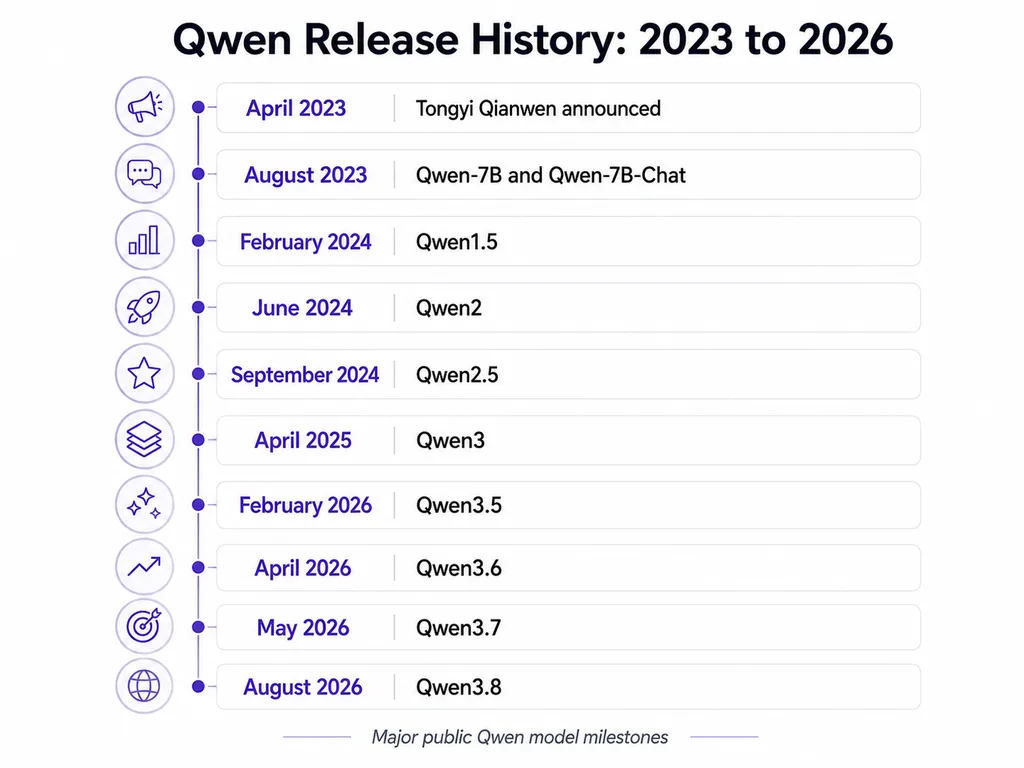
Qwen’s public history began with Alibaba Cloud’s announcement of Tongyi Qianwen on April 11, 2023. The first downloadable Qwen language models, Qwen-7B and Qwen-7B-Chat, followed on August 3, 2023.
Since then, the family has evolved through Qwen1.5, Qwen2, Qwen2.5, Qwen3, Qwen3.5, Qwen3.6, Qwen3.7, and Qwen3.8, while also expanding into vision, coding, audio, reasoning, image generation, retrieval, and agent-oriented models.
Quick answer: Qwen3.8 is the current general-purpose Qwen generation. Qwen3.8-Max, the latest hosted flagship, was announced on August 2, 2026. The Qwen3.8-2.4T-A95B open-weight checkpoint became available on August 12, followed by Qwen3.8-27B on August 14. The newest model by date and the most capable hosted model are therefore not necessarily the same model.
This timeline focuses on major public model milestones rather than every API alias, quantized checkpoint, monthly image-editing update, or dated snapshot. It also separates model releases from products such as Qwen Studio and Qwen Code.
Independent verification note: Try-Qwen-AI.com is an independent Qwen resource. Dates were checked against official Alibaba, Qwen, GitHub, Hugging Face, and ModelScope sources. A release date can refer to an announcement, API availability, or public model-weight availability, so the methodology used in this timeline is explained below.
Qwen Release History at a Glance
| Date | Release | Category | Why it mattered |
|---|---|---|---|
| April 11, 2023 | Tongyi Qianwen announced | Hosted language model | Alibaba Cloud publicly introduced the model that became the Qwen family. |
| August 3, 2023 | Qwen-7B and Qwen-7B-Chat | Open-weight language models | Marked the beginning of Qwen’s public downloadable model history. |
| August 22, 2023 | Qwen-VL and Qwen-VL-Chat | Vision-language | Added image understanding, text reading, visual grounding, and multimodal chat. |
| September 25, 2023 | Qwen-14B and Qwen-Agent | Language model and agent framework | Expanded the model-size range and introduced an official framework for tool-using assistants. |
| November 30, 2023 | Qwen-72B and Qwen-1.8B | Language models | Extended the original generation toward both larger flagship and smaller deployment options. |
| November 30, 2023 | Qwen-Audio | Audio-language | Introduced an audio branch capable of processing speech, sound, music, and text. |
| February 5, 2024 | Qwen1.5 | General-purpose generation | Expanded model sizes and improved compatibility with common inference frameworks. |
| March 28, 2024 | Qwen1.5-MoE-A2.7B | Mixture-of-experts | Became Qwen’s first public MoE model. |
| April 16, 2024 | CodeQwen1.5 | Coding | Established Qwen’s first dedicated coding-model branch. |
| June 6, 2024 | Qwen2 | General-purpose generation | Improved multilingual, coding, mathematics, context, and model-size coverage. |
| August 9, 2024 | Qwen2-Audio | Audio-language | Added voice chat and general audio analysis without requiring a separate ASR stage. |
| August 29, 2024 | Qwen2-VL | Vision-language | Added dynamic-resolution image input, long-video understanding, visual localization, and device-agent use cases. |
| September 19, 2024 | Qwen2.5 | General, coding, and mathematics | Released a coordinated family with stronger knowledge, structured output, long generation, coding, and math. |
| November 12, 2024 | Qwen2.5-Coder full family | Coding | Completed the coding range with models from 0.5B to 32B. |
| November 28, 2024 | QwQ-32B-Preview | Reasoning | Opened a dedicated experimental reasoning line focused on longer problem-solving chains. |
| December 25, 2024 | QVQ-72B-Preview | Visual reasoning | Extended deliberate reasoning from text tasks into vision-language problems. |
| January 26, 2025 | Qwen2.5-VL | Vision-language | Improved document, chart, video, localization, structured extraction, and visual-agent capabilities. |
| January 28, 2025 | Qwen2.5-Max | Hosted flagship | Introduced a large hosted MoE flagship in the Qwen2.5 generation. |
| March 6, 2025 | QwQ-32B | Reasoning | Turned the earlier reasoning preview into a released open-weight reasoning model. |
| March 26, 2025 | Qwen2.5-Omni | Omnimodal | Accepted text, image, audio, and video input and produced streamed text or speech output. |
| April 29, 2025 | Qwen3 | General-purpose generation | Integrated thinking and non-thinking behavior into the main family and included dense and MoE models. |
| July 22, 2025 | Qwen3-Coder and Qwen Code | Coding model and developer product | Paired an agent-oriented coding model with an open-source terminal coding agent. |
| July–August 2025 | Qwen3-2507 series | Dated Qwen3 updates | Updated Instruct and Thinking checkpoints and expanded long-context support. |
| August 4, 2025 | Qwen-Image | Image generation | Created a dedicated image-generation and editing branch with strong text rendering. |
| September 11, 2025 | Qwen3-Next-80B-A3B | Architecture research | Introduced an ultra-sparse hybrid-attention architecture that later influenced Qwen3.5. |
| September 22, 2025 | Qwen3-VL | Vision-language | Upgraded visual perception, spatial reasoning, video understanding, and visual-agent behavior. |
| September 2025 | Qwen3-Omni | Omnimodal | Added native end-to-end processing of text, images, audio, and video with real-time output. |
| September 23, 2025 | Qwen3-Max | Hosted flagship | Expanded the hosted flagship line with a trillion-parameter Qwen3 model. |
| January 2026 | Qwen3-TTS and Qwen3-ASR | Speech generation and recognition | Separated advanced speech synthesis and recognition into dedicated Qwen3 services and models. |
| February 2, 2026 | Qwen3-Coder-Next | Coding | Delivered a compact open-weight model designed for coding agents and local development. |
| February 9, 2026 | Qwen-Image-2.0 | Image generation | Improved professional layouts, infographics, photorealism, and multi-image workflows. |
| February 15–16, 2026 | Qwen3.5 | Native multimodal generation | Introduced a unified vision-language foundation, efficient hybrid architecture, and broader agent focus. |
| February–March 2026 | Additional Qwen3.5 sizes | Open-weight models | Expanded the generation from the first large MoE checkpoint to dense and smaller deployment sizes. |
| March 29, 2026 | Qwen3.5-Omni | Omnimodal | Scaled the native omni branch across text, images, audio, and audiovisual content. |
| April 1, 2026 | Qwen3.6-Plus | Hosted multimodal agent | Focused the generation on practical coding, multimodal, and real-world agent workflows. |
| April 14–16, 2026 | Qwen3.6-35B-A3B | Open-weight MoE | Brought Qwen3.6 agentic coding capabilities to an open 35B MoE checkpoint. |
| April 21–22, 2026 | Qwen3.6-27B | Open-weight dense model | Provided a dense Qwen3.6 model aimed at coding and practical deployment. |
| May 19, 2026 | Qwen3.7-Max | Hosted flagship agent | Advanced the hosted line toward long-running coding, office, and autonomous agent work. |
| May 31, 2026 | Qwen3.7-Plus | Hosted multimodal agent | Combined visual and language capabilities in a general multimodal agent model. |
| July 20, 2026 | Qwen-Image-3.0 | Image generation | Expanded complex layout generation, small-text rendering, multilingual design, and practical content creation. |
| August 2, 2026 | Qwen3.8-Max | Hosted flagship | Became Qwen’s most capable hosted model, emphasizing coding, professional work, and long-horizon agents. |
| August 12, 2026 | Qwen3.8-2.4T-A95B | Open-weight Max-class model | Brought a Qwen-Max-class 2.4T-parameter model to public downloadable release. |
| August 14, 2026 | Qwen3.8-27B | Open-weight dense multimodal model | Became the newest Qwen3.8 open-model release by official availability date. |
The table tracks major milestones rather than every checkpoint. For example, quantized repositories, API snapshots, monthly image-editing versions, and regional Model Studio aliases are excluded unless they changed the direction of the Qwen family.
How Dates Were Selected for This Qwen Timeline
A Qwen model can have several legitimate dates:
- Announcement date: when Qwen publishes a blog post or announcement.
- API availability date: when a hosted Model ID becomes callable.
- Open-weight availability date: when official weights appear on Hugging Face or ModelScope.
- Repository record date: when an official GitHub repository adds the release to its News section.
- Model-card update date: when documentation or files are updated after release.
This article follows these rules:
- Use the earliest clearly documented official public availability date when the event is a hosted release.
- Use the official weight-availability date when the event specifically concerns an open-weight model.
- Show a date range when an announcement and public repository release occurred on different dates.
- Use month-level dates when the available official records do not establish one consistent day across channels.
- Do not treat a documentation edit or quantized conversion as a new model generation.
This is why Qwen3 appears as April 29, 2025 in the official repository even though the launch announcement may be dated April 28 in another time zone. Qwen3.5 similarly has a February 15 announcement and a February 16 open-model repository release.
Qwen in 2023: From Tongyi Qianwen to the First Open Models
April 11, 2023: Tongyi Qianwen is introduced
Alibaba Cloud publicly unveiled Tongyi Qianwen on April 11, 2023. The initial announcement described a Chinese- and English-capable large language model intended for Alibaba products, enterprise customization, and cloud API access.
Tongyi Qianwen was initially a hosted model and enterprise service. The Qwen name later became the international name used across the public model repositories and product family.
The original announcement is available from Alibaba Group.
August 3, 2023: the first open-weight Qwen models
Qwen’s public open-model history began with Qwen-7B and Qwen-7B-Chat. The official repository records their release on Hugging Face and ModelScope on August 3, 2023.
This established the pattern that continued across later generations: a base model for further development and an instruction- or chat-tuned model for direct interaction.
August 22, 2023: Qwen gains vision
Qwen-VL and Qwen-VL-Chat created Qwen’s first public vision-language branch. The models could understand images, read text inside images, localize visual elements, and participate in multimodal conversations.
September and November 2023: the first family expands
Qwen-14B arrived on September 25 alongside Qwen-Agent. Qwen-72B and Qwen-1.8B followed on November 30, extending the first generation in two directions:
- A larger 72B model for stronger general capability.
- A smaller 1.8B model for lower-resource deployment.
Qwen-Audio was also released in November 2023, adding speech, sound, music, and general audio understanding to the growing model family.
Qwen in 2024: Qwen1.5, Qwen2, and Qwen2.5
February 5, 2024: Qwen1.5
Qwen1.5 was the first clearly numbered upgrade to the original Qwen language-model generation. It widened the model-size range, improved developer compatibility, and reduced dependence on custom remote model code.
On March 28, Qwen released Qwen1.5-MoE-A2.7B, its first public mixture-of-experts model. The model demonstrated how a larger total architecture could activate a smaller subset of parameters during inference.
April 16, 2024: CodeQwen1.5
CodeQwen1.5 created Qwen’s dedicated coding line. It targeted code generation, completion, repair, and multilingual programming tasks. The branch was later renamed Qwen-Coder when Qwen2.5-Coder was introduced.
June 6, 2024: Qwen2
Qwen2 marked a larger generational transition. The release included dense models and a mixture-of-experts model, expanded multilingual coverage beyond Chinese and English, improved coding and mathematics, and offered longer context in selected sizes.
The official Qwen2 announcement introduced sizes from 0.5B to 72B, including Qwen2-57B-A14B as the MoE option.
August 2024: Qwen2-Audio and Qwen2-VL
Qwen2-Audio was released on August 9. It supported voice instructions and general audio analysis without requiring users to run a separate speech-recognition model first.
Qwen2-VL followed on August 29. It added dynamic-resolution vision processing, video understanding, visual localization, broader text recognition, and agent scenarios involving phones and robots.
September 19, 2024: Qwen2.5
Qwen2.5 was released as a coordinated family rather than a single general model. The launch included:
- General-purpose Qwen2.5 language models.
- Qwen2.5-Coder models.
- Qwen2.5-Math models.
- Hosted Qwen-Plus and Qwen-Turbo services.
The generation improved instruction following, structured data understanding, JSON generation, coding, mathematics, and long-form output. The full six-size Qwen2.5-Coder family was completed in November 2024.
November 28, 2024: QwQ opens the reasoning branch
QwQ-32B-Preview was an experimental reasoning model designed to spend more tokens working through difficult mathematics, science, coding, and logical problems.
QwQ initially existed as a specialist branch. Its lessons later influenced Qwen3, which integrated thinking and non-thinking behavior into the general-purpose family.
Qwen in 2025: Reasoning, Qwen3, Coding Agents, Vision, and Omni
January to March 2025: Qwen2.5 expands across modalities
Qwen2.5-VL was released on January 26, improving document understanding, charts, long video, visual localization, structured extraction, and computer-use behavior.
Qwen2.5-Max followed as a hosted flagship at the end of January. QwQ-32B was released on March 6, moving the dedicated reasoning branch beyond its Preview stage.
Qwen2.5-Omni arrived on March 26. It accepted text, images, audio, and video, while supporting streamed text and speech responses. This was an important step from separate modality-specific branches toward unified multimodal interaction.
April 29, 2025: Qwen3
Qwen3 was the generation in which deliberate reasoning became part of the main general-purpose family.
The official release included dense and MoE sizes and introduced seamless switching between:
- Thinking mode for mathematics, coding, logic, and difficult reasoning.
- Non-thinking mode for faster general chat and instruction following.
Qwen3 also expanded multilingual support, tool use, agent capability, coding, and human-preference alignment. The release is documented in the official Qwen3 repository.
July and August 2025: Qwen3-2507 updates
Qwen released a sequence of updated Qwen3 checkpoints carrying the suffix 2507. This suffix represents the July 2025 update cycle; it is not a separate generation called “Qwen3.2507.”
The updates separated certain models into explicit Instruct and Thinking checkpoints and expanded context support. Examples included:
Qwen3-235B-A22B-Instruct-2507.Qwen3-235B-A22B-Thinking-2507.Qwen3-30B-A3B-Instruct-2507.Qwen3-30B-A3B-Thinking-2507.
July 22, 2025: Qwen3-Coder and Qwen Code
Qwen3-Coder shifted the coding family toward agentic software development. Its flagship open model was designed for repository-scale context, tool use, browser use, and execution-driven coding tasks.
Qwen Code launched alongside the model as a command-line coding agent. This distinction is important:
- Qwen3-Coder is a model family.
- Qwen Code is software that can connect to Qwen and other configured model providers.
See the dedicated Qwen Code guide for the product rather than treating each software release as a new foundation-model version.
August and September 2025: image, architecture, vision, and omni branches
Qwen-Image was released on August 4 as a dedicated image-generation and editing model, with particular emphasis on rendering text inside images.
Qwen3-Next arrived in September as an ultra-sparse hybrid-attention architecture designed for more efficient long-context inference. The official announcement described it as a foundation for the future Qwen3.5 architecture.
Qwen3-VL and Qwen3-Omni expanded the multimodal branches later that month:
- Qwen3-VL focused on visual perception, spatial reasoning, video, long context, and visual agents.
- Qwen3-Omni unified text, image, audio, and video understanding with real-time text and speech output.
Qwen in 2026: Qwen3.5 Through Qwen3.8
January and February 2026: specialist branches continue
Qwen3-TTS and Qwen3-ASR advanced speech synthesis and recognition in January. Qwen3-Coder-Next followed on February 2 as a smaller open-weight coding model designed for coding agents and local development.
Qwen-Image-2.0 was launched on February 9, adding stronger professional infographics, layouts, multi-image creation, and photorealistic output.
February 15–16, 2026: Qwen3.5
Qwen3.5 represented a more fundamental architectural change than an ordinary Qwen3 snapshot.
The generation introduced:
- A unified native vision-language foundation.
- An efficient hybrid architecture combining Gated Delta Networks and sparse MoE design.
- Broader reinforcement-learning environments for agents.
- Support for 201 languages and dialects.
- A stronger focus on coding, agents, reasoning, and visual understanding in the same foundation.
The announcement was published on February 15, while the official open-model repository records the first Qwen3.5-397B-A17B release on February 16. Additional sizes followed on February 24 and March 2.
March 29, 2026: Qwen3.5-Omni
Qwen3.5-Omni extended the generation into fully omnimodal interaction, processing text, images, audio, and audiovisual content. It should be viewed as a specialist Qwen3.5 branch rather than a replacement for every general-purpose Qwen3.5 model.
April 2026: Qwen3.6
Qwen3.6 prioritized stability and practical real-world utility. The generation emphasized repository-level coding, front-end development, multimodal work, and preserving reasoning context across longer sessions.
The release sequence included:
- Qwen3.6-Plus on April 1 as a hosted multimodal agent model.
- Qwen3.6-35B-A3B announced April 14 and made available in official open repositories on April 16.
- Qwen3.6-27B announced April 21 and made available on April 22.
May 2026: Qwen3.7
The public Qwen3.7 line centered on hosted agent models:
- Qwen3.7-Max, announced May 19, targeted coding, office automation, tool use, and long-running autonomous workflows.
- Qwen3.7-Plus, announced May 31, added a more explicitly multimodal vision-language agent foundation.
Qwen3.7 is therefore important in the hosted-model history even though its release pattern differs from generations launched first as a broad collection of downloadable checkpoints.
August 2026: Qwen3.8
Qwen3.8 is the current Qwen general-purpose generation as of this article’s verification date.
It introduced three different milestones:
- Qwen3.8-Max: the latest hosted flagship, announced on August 2.
- Qwen3.8-2.4T-A95B: the first open release of a Qwen-Max-class checkpoint, made available on August 12.
- Qwen3.8-27B: a dense native vision-language model released on August 14.
The official Qwen3.8 repository describes improvements in coding, professional work, research, autonomous planning, environment feedback, development-tool compatibility, and flexible reasoning control.
For a focused comparison of the current models, use the separate latest Qwen model guide.
Main Qwen Versions in Order
| Main version | Initial public date | Primary change | Typical distribution |
|---|---|---|---|
| Tongyi Qianwen / original Qwen | April–August 2023 | Introduced the hosted model, then the first public Qwen language-model weights. | Hosted service and open-weight models |
| Qwen1.5 | February 5, 2024 | Expanded model sizes, developer compatibility, and introduced Qwen’s first MoE model. | Open-weight models |
| Qwen2 | June 6, 2024 | Improved multilingual, context, coding, mathematics, dense, and MoE options. | Open-weight and hosted models |
| Qwen2.5 | September 19, 2024 | Coordinated general, coding, and mathematics families with stronger structured output and instruction following. | Open-weight and hosted models |
| Qwen3 | April 29, 2025 | Integrated thinking and non-thinking modes into the main general-purpose family. | Open-weight and hosted models |
| Qwen3.5 | February 15–16, 2026 | Introduced a native vision-language foundation, efficient hybrid architecture, and broader agent training. | Open-weight and hosted models |
| Qwen3.6 | April 1, 2026 | Focused on practical agentic coding, multimodal utility, stability, and preserved reasoning context. | Hosted and open-weight models |
| Qwen3.7 | May 19, 2026 | Advanced the hosted flagship line toward long-running multimodal agents. | Primarily hosted Max and Plus models in the public release line |
| Qwen3.8 | August 2–14, 2026 | Brought Max-class capability to open release and improved long-horizon coding and professional agents. | Hosted and open-weight models |
The numbering is not a promise that every decimal value will appear publicly. The major public line moved from Qwen3 to Qwen3.5 rather than releasing separately branded Qwen3.1, Qwen3.2, Qwen3.3, and Qwen3.4 generations.
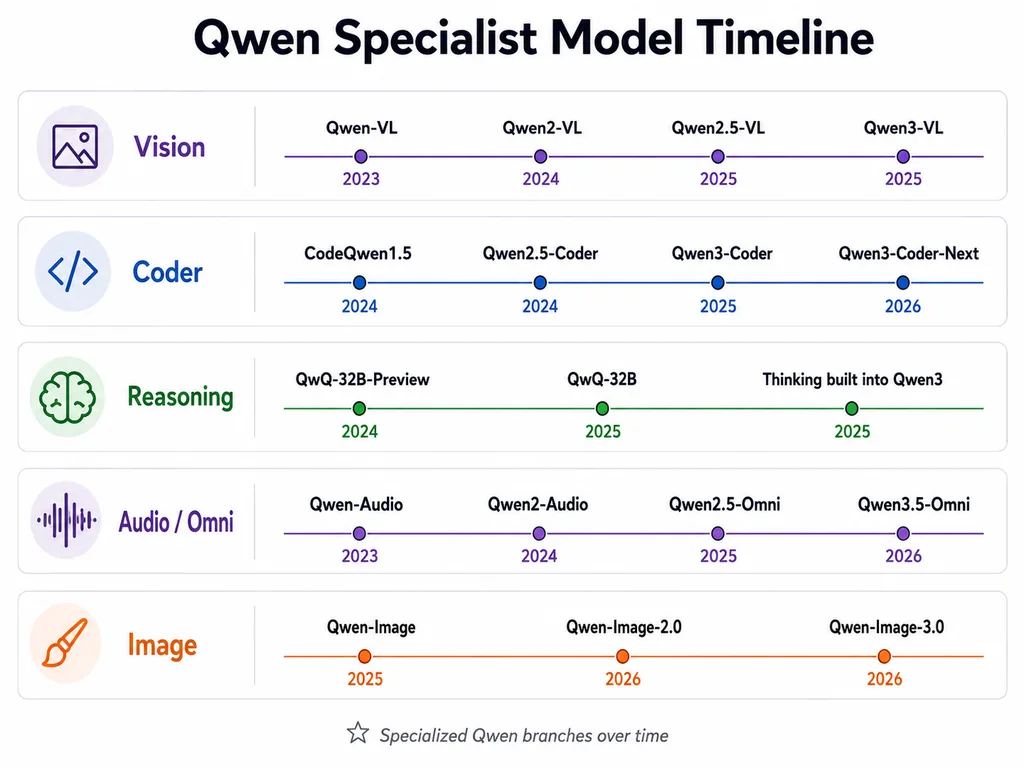
Qwen Vision-Language Model Timeline
| Date | Vision release | Main change |
|---|---|---|
| August 22, 2023 | Qwen-VL | Image understanding, OCR-like reading, grounding, and multimodal chat. |
| August 29, 2024 | Qwen2-VL | Dynamic resolution, long-video understanding, visual localization, and device agents. |
| January 26, 2025 | Qwen2.5-VL | Documents, charts, structured extraction, longer video, and visual-agent improvements. |
| September 22, 2025 | Qwen3-VL | Deeper visual reasoning, spatial understanding, video dynamics, long context, and visual action. |
| February 2026 | Qwen3.5 | Integrated vision and language into the main native multimodal foundation. |
| August 2026 | Qwen3.8-Max and Qwen3.8-27B | Continued native text, image, and video support in selected current models. |
After Qwen3.5, vision is not always confined to a model carrying the VL suffix. Some general-purpose Qwen models are natively multimodal.
Qwen Coder Model Timeline
| Date | Coding release | Main change |
|---|---|---|
| April 16, 2024 | CodeQwen1.5 | Created the first dedicated Qwen coding-model family. |
| September 19, 2024 | Qwen2.5-Coder | Renamed the branch to Qwen-Coder and expanded code pretraining and language coverage. |
| November 12, 2024 | Qwen2.5-Coder full family | Completed the model range from 0.5B through 32B. |
| July 22, 2025 | Qwen3-Coder | Shifted toward repository-scale, tool-using, browser-using coding agents. |
| February 2, 2026 | Qwen3-Coder-Next | Focused on compact open-weight coding agents and local development. |
| April–August 2026 | Qwen3.6 and Qwen3.8 | Strong coding and agent behavior increasingly became part of the general flagship families. |
The dedicated Coder branch remains useful, but newer general-purpose Qwen generations can also provide advanced coding and agent capabilities. See the Qwen Coder model guide for a model-by-model comparison.
Qwen Reasoning Model Timeline
| Date | Reasoning release | Main change |
|---|---|---|
| November 28, 2024 | QwQ-32B-Preview | Opened an experimental text-reasoning branch. |
| December 25, 2024 | QVQ-72B-Preview | Applied deliberate reasoning to visual inputs. |
| March 6, 2025 | QwQ-32B | Released a production-oriented open-weight reasoning model. |
| April 29, 2025 | Qwen3 | Integrated switching between thinking and non-thinking modes into the main family. |
| July 2025 | Qwen3 Thinking checkpoints | Separated selected updated Qwen3 models into explicit Instruct and Thinking variants. |
| 2026 | Qwen3.5–Qwen3.8 reasoning controls | Expanded reasoning control, preservation, effort settings, and agent-oriented planning. |
QwQ remains historically important, but reasoning is no longer limited to a model whose name begins with QwQ. It became a configurable behavior within later Qwen generations.
Qwen Audio and Omni Model Timeline
| Date | Audio or Omni release | Main change |
|---|---|---|
| November 30, 2023 | Qwen-Audio | Processed speech, sounds, music, and text and returned text. |
| August 9, 2024 | Qwen2-Audio | Added direct voice chat and stronger general audio analysis. |
| March 26, 2025 | Qwen2.5-Omni | Unified text, image, audio, and video input with text and speech output. |
| September 2025 | Qwen3-Omni | Introduced a native end-to-end omnimodal foundation with real-time streaming. |
| January 2026 | Qwen3-TTS and Qwen3-ASR | Expanded specialist speech generation and recognition. |
| March 29, 2026 | Qwen3.5-Omni | Scaled native omni-modal understanding and interaction on the Qwen3.5 foundation. |
Qwen Image Model Timeline
| Date | Image release | Main change |
|---|---|---|
| August 4, 2025 | Qwen-Image | Established the dedicated image-generation and editing family with strong text rendering. |
| February 9, 2026 | Qwen-Image-2.0 | Improved professional graphics, infographics, photorealism, and multi-image workflows. |
| July 20, 2026 | Qwen-Image-3.0 | Added more complex layouts, small-text rendering, multilingual design, and practical content creation. |
Monthly or dated Qwen-Image-Edit releases can add important editing features, but they are not all treated as new numbered foundation-model generations in this high-level timeline.
Qwen Models vs Qwen Products
One of the most common timeline mistakes is treating a software-product update as a foundation-model release.
| Name | Type | Relationship to Qwen models |
|---|---|---|
| Qwen Studio | Consumer AI application | Provides chat, research, document, multimodal, and creative workflows using supported Qwen models and tools. |
| Qwen Code | Coding-agent software | Runs in terminals, desktop interfaces, IDEs, or automation and connects to configured model providers. |
| Qwen-Agent | Developer framework | Helps developers build Qwen-based agents with tools and external services. |
| Alibaba Cloud Model Studio | Cloud API and deployment platform | Hosts Qwen and other models through regional Model IDs, APIs, quotas, and pricing. |
| QwenCloud | Managed Qwen API service | Provides hosted access to current Qwen models through supported API protocols. |
| Qwen3-Coder | Model family | Provides the underlying coding intelligence and is distinct from the Qwen Code application. |
A new Qwen Code version does not automatically mean that a new Qwen foundation model has been released. Likewise, adding a model to Qwen Studio does not necessarily mean that the model itself was launched on the same day.
Use the separate Qwen Studio and Qwen Code updates page for software and product changes.
Open-Weight vs Hosted Qwen Releases
Qwen history contains both downloadable and managed releases.
| Release type | What it means | Examples |
|---|---|---|
| Open-weight model | Official model weights can be downloaded from a repository such as Hugging Face or ModelScope, subject to the applicable license. | Qwen3-235B-A22B, Qwen3.5-397B-A17B, Qwen3.8-27B |
| Hosted model | The model is accessed through an application or API, while the provider manages inference infrastructure. | Qwen3.7-Max, Qwen3.7-Plus, Qwen3.8-Max |
| Hosted version of an open model | A downloadable model is also offered through a managed API. | Qwen3.8-27B and Qwen3.8-2.4T-A95B |
| Preview model | An early hosted or public version released before a stable or finalized model. | Qwen3-Max-Preview and QwQ-32B-Preview |
| Snapshot model | A dated or fixed version intended to preserve a particular model state. | Model IDs ending in a date or a suffix such as 2507 |
“Open-weight” is more precise than claiming that every Qwen model is open source. Licenses differ between models, and some hosted flagship services do not provide downloadable weights under the same product identifier.
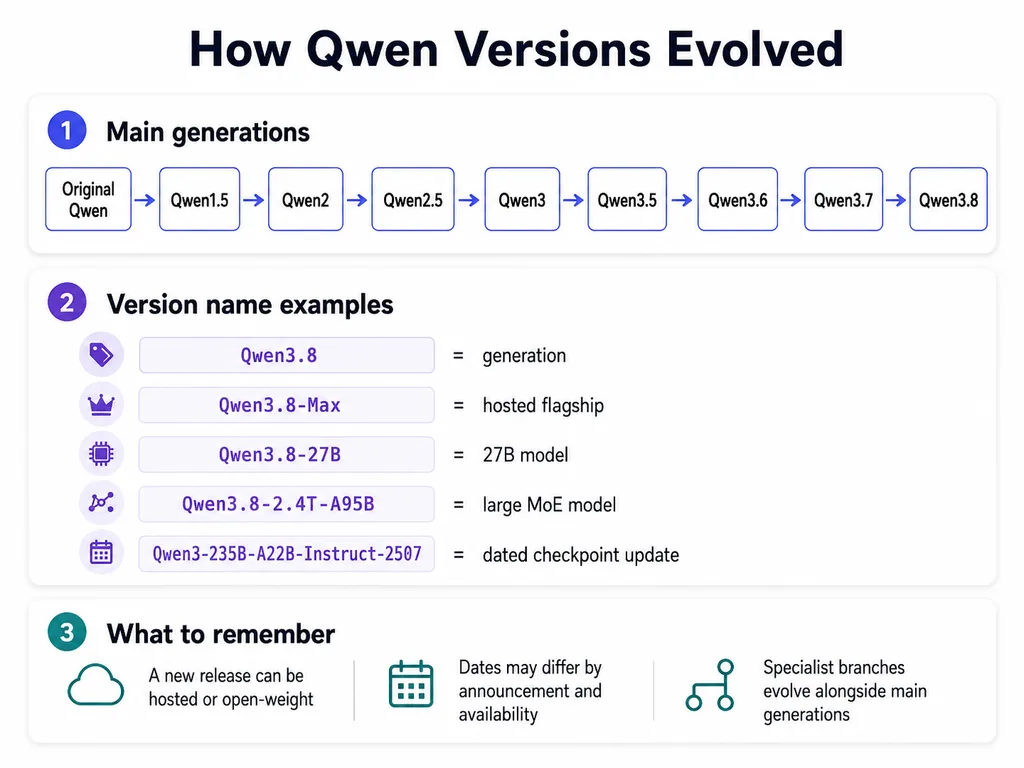
How Qwen Version Names Work
| Example | What the name communicates |
|---|---|
Qwen3.8 | The broad model generation. |
Qwen3.8-27B | Generation 3.8 with approximately 27 billion parameters. |
Qwen3.8-2.4T-A95B | Approximately 2.4 trillion total parameters and about 95 billion active parameters per step. |
Qwen3-235B-A22B | A 235B-total-parameter MoE model with approximately 22B active parameters. |
Qwen3-235B-A22B-Instruct-2507 | Qwen3, 235B total, 22B active, instruction-tuned, July 2025 update. |
Qwen3-235B-A22B-Thinking-2507 | The explicit Thinking variant from the same July 2025 update cycle. |
qwen3.7-max | A hosted API identifier for the Max tier of Qwen3.7. |
Qwen3-Coder-Next | A specialist coding model and architectural update, not the next general-purpose generation. |
For a deeper naming reference covering product labels, API IDs, and checkpoints, see Qwen model names explained.
Mainline, Snapshot, Preview, and Dated Models
Mainline models
A mainline hosted name does not contain a release date. Examples include qwen3.7-max or qwen3.7-plus. The provider can update a mainline model while retaining the same general identifier.
Snapshot models
A snapshot preserves a specific version or date. It is useful when reproducibility matters, but snapshots can have shorter lifecycle windows than mainline models.
Preview models
A Preview label indicates an early version that may change before a stable release. Preview availability should not be interpreted as a permanent production guarantee.
Dated open checkpoints
Suffixes such as 2507 commonly represent a year-and-month update. They identify a checkpoint revision inside a generation rather than creating a new major generation.
Why Qwen Release Dates Differ Between Sources
- Time zones: a launch can be dated one day in China and the next day in another region.
- Announcement vs availability: a blog post may appear before weights or API access become public.
- Hosted vs open release: the managed model can launch before its related open-weight checkpoint.
- Repository records: the GitHub News entry may use the date when files were added rather than the announcement date.
- Later documentation edits: a model card’s latest modification date is not necessarily the original release date.
- Preview and stable stages: a preview and its final version are separate milestones.
Examples include:
- Qwen3 was announced around April 28, while its official repository records the release on April 29.
- Qwen3.5 has a February 15 announcement and a February 16 first open-weight release.
- Qwen3.6-35B-A3B was announced April 14 and recorded as available in the open repositories on April 16.
- Qwen3.6-27B was announced April 21 and made available on April 22.
A trustworthy timeline should state which event its date represents instead of silently choosing whichever date appears first in search results.
What Is the Current Qwen Version?
As of August 22, 2026, Qwen3.8 is the current general-purpose Qwen generation.
- Qwen3.8-Max is the current latest hosted flagship.
- Qwen3.8-27B is the newest current open-model release by official availability date.
- Qwen3.8-2.4T-A95B is the current Max-class open-weight checkpoint.
This article owns the historical timeline. The page What Is the Latest Qwen Model? owns the freshness-focused query and should be updated whenever a newer model appears.
Are Older Qwen Versions Still Available?
A new Qwen release does not automatically retire the preceding generation.
Older models may remain:
- Available as downloadable weights.
- Available through a hosted API.
- Available only in specific regions.
- Deprecated but still callable during a migration period.
- Fully retired from a particular provider.
Release history and lifecycle status are separate datasets. Check the dedicated Qwen model deprecations and migration deadlines page before relying on an older hosted Model ID.
A Model Studio endpoint can be retired without making independently downloaded weights stop functioning. Likewise, another API provider can maintain a Qwen model after Alibaba Cloud changes its own hosted catalog.
How to Verify Future Qwen Releases
- Check the official Qwen research and announcement page.
- Check the News section of the relevant official GitHub repository.
- Confirm whether the release is hosted, open-weight, preview, snapshot, or stable.
- Open the official Hugging Face or ModelScope model card for downloadable releases.
- Confirm the exact API Model ID in the official service catalog.
- Separate the blog announcement date from the weight-availability date.
- Check whether the release is a general model, specialist branch, product, or software update.
- Record the source and a Last Verified date.
Third-party timelines can become outdated within days. For example, a timeline finalized on August 12, 2026 could correctly identify Qwen3.8-2.4T-A95B as the newest open Qwen model at that moment, then become outdated when Qwen3.8-27B appeared on August 14.
Frequently Asked Questions
When was Qwen first released?
Alibaba Cloud announced Tongyi Qianwen on April 11, 2023. The first public downloadable Qwen language models, Qwen-7B and Qwen-7B-Chat, were released on August 3, 2023.
What was the first Qwen model?
Tongyi Qianwen was the original hosted model announced in April 2023. Qwen-7B was the first public open-weight Qwen language model.
Is Tongyi Qianwen the same as Qwen?
Tongyi Qianwen is the original Chinese product and model name. Qwen became the name used internationally across the model family, repositories, applications, and developer ecosystem.
What are the main Qwen versions in order?
The main public sequence is original Qwen, Qwen1.5, Qwen2, Qwen2.5, Qwen3, Qwen3.5, Qwen3.6, Qwen3.7, and Qwen3.8.
When was Qwen3 released?
The official Qwen3 repository records the series release on April 29, 2025. Some announcement pages and timelines use April 28 because of announcement timing or time-zone differences.
Is Qwen3-2507 a separate Qwen generation?
No. The 2507 suffix identifies the July 2025 update cycle for selected Qwen3 checkpoints. It is a dated model revision inside Qwen3, not a generation after Qwen3.
Why did Qwen jump from Qwen3 to Qwen3.5?
Public model numbering does not need to expose every internal iteration. Qwen3.5 was the next major publicly branded foundation generation after Qwen3 and incorporated architectural work previewed by Qwen3-Next.
Was Qwen3.7 an open-weight generation?
The public Qwen3.7 release line was centered on hosted Qwen3.7-Max and Qwen3.7-Plus models. It did not follow exactly the same broad open-checkpoint release pattern as Qwen3, Qwen3.5, or Qwen3.8.
What is the current Qwen version?
Qwen3.8 is the current general-purpose generation as of August 22, 2026. Qwen3.8-Max is the latest hosted flagship, while Qwen3.8-27B is the newest open Qwen model by official release date.
Is Qwen Code a Qwen model?
No. Qwen Code is coding-agent software. Qwen3-Coder is a model family. Qwen Code can connect to Qwen models or other supported model providers through its configuration.
Is every Qwen model open source?
No. Qwen includes open-weight models, hosted proprietary models, API services, and products. Licenses also differ between downloadable models. Check the exact model card rather than applying one license description to the whole family.
Why do different sites give different Qwen release dates?
One source may use the announcement date, another may use API availability, and another may use the Hugging Face or GitHub release date. Time zones, previews, and later documentation updates can also create one- or two-day differences.
Does a new Qwen version retire the old version automatically?
No. A new release and a retirement are separate lifecycle events. Continue checking the official provider’s decommissioning notices for any hosted Model ID used in production.
Where are official Qwen model weights released?
Official downloadable Qwen weights are generally published through the Qwen organizations on Hugging Face and ModelScope. Use links from the official Qwen repository or announcement to avoid unofficial or mislabeled copies.
Official Sources Used
- Alibaba Group announcement of Tongyi Qianwen — April 11, 2023
- Original Qwen repository and 2023 release records
- Official Qwen2 announcement
- Official Qwen2.5 announcement
- Official Qwen3 repository and version history
- Official Qwen3.5 announcement
- Official Qwen3.6-Plus announcement
- Official Qwen3.7-Max announcement
- Official Qwen3.7-Plus announcement
- Official Qwen3.8-Max announcement
- Official Qwen3.5, Qwen3.6, and Qwen3.8 open-model repository
- Official Qwen2-VL announcement
- Official Qwen2.5-VL announcement
- Official Qwen3-Coder and Qwen Code announcement
- Current official Qwen research and release index
Verification status: Major dates were checked against official announcements, repository News entries, and model-availability records. The article deliberately distinguishes announcement dates, API releases, and open-weight availability. Minor snapshots, quantized conversions, and regional aliases are omitted unless they represent an important historical milestone.
Try-Qwen-AI.com is an independent Qwen resource. It is not affiliated with, endorsed by, or operated by Alibaba Group, Alibaba Cloud, QwenCloud, or the Qwen team.
Last verified: August 22, 2026.