
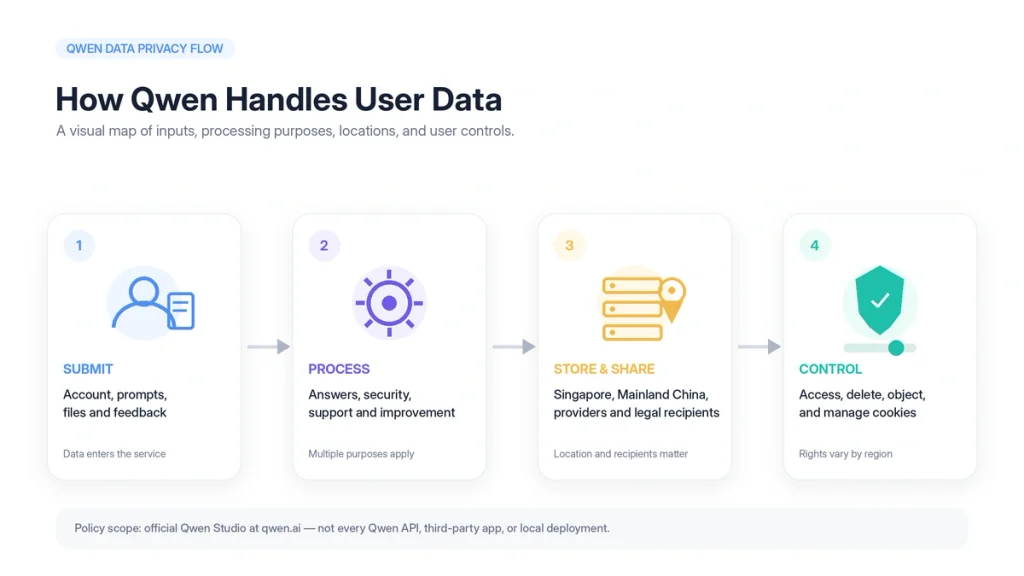
Qwen’s current privacy policy says the official Qwen Studio service may collect account details, prompts, uploaded content, feedback, technical logs, usage information, cookies, and feature-specific voice or video data. It also says de-identified User Content and Feedback may be used to train and improve Qwen’s services, including its AI models. Personal data may be stored or processed in Singapore and Mainland China, and the policy does not promise one universal deletion period for every data category.
This explanation focuses on the consumer-facing Qwen Studio service available through qwen.ai. It does not automatically describe Alibaba Cloud Model Studio, Qwen Code configured with another provider, a third-party app offering Qwen models, or a Qwen model you run on your own hardware.
Privacy takeaway: Qwen Studio should not be treated as a zero-data-retention, confidential-by-default workspace. It can be reasonable for low-risk tasks when you minimize the data you submit, but confidential, regulated, credential-bearing, or NDA-protected information requires a different deployment route and a formal review of the applicable contract.
Qwen Privacy Policy in Plain English
| Question | Plain-English answer |
|---|---|
| Does Qwen collect prompts and uploads? | Yes. User Content can include prompts and text, files, images, audio, or video submitted through supported features. |
| Can Qwen use conversations to improve its models? | The policy lists de-identified User Content and Feedback as data that may be used to train and improve the services, including AI models. |
| Does every raw chat definitely become training data? | The published policy does not establish that every raw conversation is selected or copied verbatim into a training set. It also does not disclose the selection rate or full training pipeline. |
| Is there a fixed retention period? | No single period is stated for all data. Retention depends on the purpose, legal requirements, and whether an ongoing legitimate need exists. |
| Where is personal data processed? | The current policy identifies Singapore and Mainland China and describes limited remote access by certain group entities under controls. |
| Is there a dedicated consumer training opt-out switch? | We did not find a dedicated model-improvement toggle described in the current published privacy policy. Depending on your location, you may have a right to object or restrict processing. |
| Does this policy cover local Qwen models? | No. Privacy for a local model depends on your application, network access, telemetry, plugins, storage, logs, and any remote services you connect. |
Which Qwen Service Does This Privacy Policy Cover?
The official policy, last updated May 19, 2026, governs Qwen Studio and other services accessible through qwen.ai. The named service provider is Alibaba Cloud (Singapore) Private Limited. This scope matters because “Qwen” can refer to a hosted chatbot, a cloud developer platform, a coding client, an open-weight model family, or a third-party service.
| How you access Qwen | Primary privacy layer | What to remember |
|---|---|---|
| Official Qwen Studio at qwen.ai | Qwen Privacy Policy, Terms of Service, and Cookies Notice | This is the service analyzed in this article. |
| Alibaba Cloud Model Studio | Alibaba Cloud privacy documents and Model Studio product terms | Its official documentation states that customer content is not used to develop or improve Model Studio models unless the customer separately consents. |
| Qwen Code | Qwen Code settings plus the policy of the selected authentication or API provider | Optional Qwen Code usage telemetry is separate from the prompts processed by the chosen model provider. |
| Self-hosted Qwen model | Your infrastructure, software stack, model license, and connected services | Downloading model weights does not create a connection to Qwen Studio, but the surrounding software may still transmit data. |
| Third-party website or app using Qwen | The third party’s privacy policy and its upstream model provider’s terms | A Qwen model name or Qwen-like domain does not make the service official. |
Before evaluating any privacy claim, verify the exact domain, app publisher, API provider, account type, and deployment method. A promise made for Alibaba Cloud Model Studio should not be copied to Qwen Studio, and a local deployment should not be assumed private if it sends prompts to remote tools or telemetry endpoints.
What Personal Data Does Qwen Collect?
The amount of data collected depends on which features you use. Typing a public question into a new chat exposes less information than uploading a document, enabling Memory, sending voice recordings, signing in through another platform, or submitting detailed feedback.
| Data category | Examples | Why it matters |
|---|---|---|
| Account Information | Name, email address, and information supplied when registering or communicating with Qwen | Links service activity to an account and supports authentication, communications, and account administration. |
| User Content | Prompts, conversation text, files, documents, images, audio, and video submitted through supported features | The content itself may contain personal, confidential, copyrighted, or regulated information. |
| Feedback | Thumbs-up or thumbs-down ratings, written comments, and the related conversation | The policy says the related conversation may be stored as part of feedback. |
| Communication Information | Support requests, messages, contact details, and correspondence content | May be needed to answer requests, investigate problems, or document a dispute. |
| Log Data | IP address, browser or device information, request times, and service interactions | Supports security, diagnostics, fraud prevention, and service operation. |
| Usage Data | Features used, content types, actions, access times, country or timezone indicators, and performance information | Can reveal behavior patterns even when it does not include the full prompt text. |
| Cookies and similar technologies | Session identifiers, preferences, measurement data, and advertising-related identifiers where applicable | Used for core functionality, analytics, preferences, and marketing or advertising functions described in the separate notice. |
| Third-party sign-in data | Profile or authentication information made available by a connected sign-in provider | The exact data depends on the provider and the permissions you authorize. |
| Voice, video, and feature-derived data | Recordings, facial or vocal characteristics, and data generated when speech, voice, or audiovisual features are used | The policy warns that some processing may qualify as biometric information under applicable law. |
Prompts are not the only sensitive input
A seemingly harmless prompt can become sensitive when combined with an account identifier, a document’s hidden metadata, an image of a person, customer records, source code comments, location details, or a conversation history. Files can also contain author names, revision history, embedded objects, internal URLs, and tracked changes that are not obvious in the visible document.
How Does Qwen Use Your Data?
The policy connects different data categories to different purposes and legal bases. The practical meaning is that data submitted to provide a response may also be processed for security, support, service operation, and certain improvement activities.
| Purpose | Examples of data involved | Practical meaning |
|---|---|---|
| Provide and maintain the service | Account Information, User Content, Feedback, logs, usage data, and cookies | Qwen must process a prompt and associated service data to return an answer and operate the account. |
| Personalize the experience | Conversation details and information retained through features such as Memory | Past details may influence future responses when personalization is enabled or available. |
| Prevent abuse and protect systems | User Content, account data, logs, usage data, and cookies | Inputs and activity may be analyzed to detect fraud, policy violations, attacks, or misuse. |
| Provide support and improve reliability | Feedback, logs, usage data, account data, and communications | Data can be used to troubleshoot errors, maintain features, and improve service quality. |
| Train and improve services and AI models | De-identified User Content and Feedback | The policy permits model-improvement use under a legitimate-interests basis. |
| Send marketing communications | Account and communication information | The policy ties this activity to consent where required. |
| Comply with law and protect rights or safety | Potentially all relevant categories | Data may be preserved or disclosed when required for legal, regulatory, safety, or rights-protection purposes. |
Model Improvement: What the Policy Actually Says
The most important clause for many users is the model-improvement purpose. The current Qwen privacy policy identifies de-identified User Content and Feedback as data that may be used to train and improve the accuracy, performance, and quality of the services, including Qwen’s AI models.
This supports a more precise conclusion than either “Qwen never uses chats for training” or “every raw chat is automatically placed into a training dataset.” The published policy permits improvement use, but it does not disclose:
- what percentage of conversations is selected;
- the full de-identification method;
- whether every feature follows the same internal pipeline;
- how long selected improvement data remains in each stage;
- or a dedicated consumer setting that disables this specific use across Qwen Studio.
What “de-identified” does and does not mean
De-identification is intended to reduce the ability to connect content to a person. It should not be read as a promise that the original submission was never associated with an account, IP address, device, or service log before de-identification. It is also different from a contractual promise that no content will be retained or used for improvement.
Feedback can include the related conversation
If you rate an output with the thumbs-up or thumbs-down control, the policy says Qwen will store the related conversation as part of that feedback. Avoid rating a conversation that contains sensitive information unless you have first removed or replaced that information.
Can you opt out?
At the time of verification, we did not find a dedicated in-product consumer switch described in the published privacy policy specifically for stopping model-improvement use. The policy does describe rights that may include objecting to or restricting processing, depending on your jurisdiction. A statutory objection request is not the same as a universal settings toggle, and acceptance can depend on the applicable law and Qwen’s legal grounds for processing.
Memory, Voice, Video, and Biometric-Related Processing
Qwen Memory
The privacy policy says Qwen may provide personalized services through a Memory feature that can retain certain details from conversations. This can make future responses more relevant, but it also creates a persistent privacy surface beyond the current chat.
- Do not give Memory passwords, recovery answers, identity numbers, financial details, medical records, client secrets, or private information about other people.
- Review and remove stored details through available account controls when the feature provides them.
- Do not assume deleting one visible chat automatically removes every separately stored memory or legally retained record.
Voice and video features
When you use voice, speech, audio, image, or video features, Qwen may process recordings and characteristics associated with a face or voice. The policy notes that this processing may be considered biometric information under applicable laws. The Terms of Service also place responsibility on users to obtain the necessary rights and consents before uploading another person’s facial, voice, or biometric data.
For sensitive recordings, interviews, employee calls, customer media, children’s content, or identity documents, obtain an appropriate legal and organizational review before uploading anything.
Where Is Qwen Data Stored and Processed?
The current Qwen privacy policy says the relevant personal data is stored or processed in Singapore and Mainland China. It also says certain corporate-group entities in those locations receive limited remote access where necessary, subject to security controls and authorization procedures.
For international transfers, the policy explains that privacy laws may differ between jurisdictions and describes transfer mechanisms used where applicable, including adequacy decisions and standard contractual clauses for certain transfers involving the European Economic Area, United Kingdom, or Switzerland.
Avoid two inaccurate shortcuts: “All Qwen data stays in my country” is not supported by the consumer policy, while “all Qwen data is stored only in China” is also inconsistent with the current disclosure naming both Singapore and Mainland China.
Data location is an important governance factor, but it does not by itself prove that a service is secure or insecure. A complete assessment also examines the contract, access controls, encryption, incident response, retention, subprocessors, employee access, regulatory obligations, and the sensitivity of the submitted content.
Who Can Receive Qwen Data?
The policy describes several categories of recipients that may receive personal data when relevant:
- Alibaba group companies, affiliates, and designated service providers involved in delivering the service;
- third-party service providers and partners that process data for the purposes described in the policy;
- analytics, search-engine, and other providers that help deliver, improve, or optimize services;
- prospective or completed investors, assignees, buyers, or transferees involved in a corporate transaction;
- courts, regulators, government agencies, law-enforcement bodies, professional advisers, or other parties when disclosure is legally necessary;
- and other recipients when you consent to the disclosure.
Third-party products reached through a search result, external link, plugin, or integrated service can have separate policies. Review those policies before sending data because Qwen’s consumer privacy policy does not control an independently operated third party.
How Long Does Qwen Keep Your Data?
Qwen does not publish one universal retention period covering every prompt, file, account record, security log, feedback item, cookie, and legal record. The policy says personal data is retained while there is an ongoing legitimate need or legal reason to process it. When that need ends, Qwen says it will securely delete or anonymize the data, or securely store and isolate it if immediate deletion is not possible.
The actual period can vary because different records support different purposes. Account administration, security investigations, fraud prevention, dispute resolution, tax or accounting requirements, legal claims, and regulatory duties may justify different retention windows.
What Happens When You Delete a Chat or Account?
Deleting a visible conversation, disabling a feature, deleting an account, and submitting a formal privacy request are different actions. Do not assume that one action instantly removes every copy from operational systems, backups, security records, feedback records, improvement datasets, or records retained for legal reasons.
- Deleting a chat may remove it from your visible history, but the public policy does not provide a universal immediate-erasure guarantee for every associated record.
- Deleting an account ends normal account access, but the policy allows continued retention in some circumstances.
- Submitting an erasure request invokes applicable privacy rights, but exceptions may apply when retention is legally required or otherwise permitted.
Before deleting an account, export or save any content you are permitted to keep. After making a privacy request, retain the confirmation and correspondence for your records.
Qwen Cookies and Advertising Technologies
Qwen publishes a separate Cookies Notice. It describes first-party and third-party technologies, session and persistent cookies, strictly necessary cookies, and advertising or measurement cookies. Necessary cookies support core functions such as security, authentication, and preference storage, while non-essential technologies can support analytics, campaign measurement, or personalized advertising.
Use the Manage Cookies control on the official Qwen site to review available choices. Cookie preferences can be specific to a browser or device, so repeat the review when you change browsers, clear storage, use another device, or create a separate browser profile.
- Reject non-essential cookies when they are unnecessary for your use case.
- Remember that blocking browser cookies does not change how submitted prompts are processed on Qwen’s servers.
- Review the Cookies Notice again after major policy or product updates.
Your Qwen Privacy Rights
The rights available to you depend on your country or region. The current policy lists rights that may include:
- accessing your personal data and information about its processing;
- requesting erasure or deletion;
- updating or correcting inaccurate data;
- requesting data portability;
- restricting or objecting to certain processing;
- withdrawing consent where processing relies on consent;
- and complaining to a competent data-protection authority.
Qwen’s published privacy contact is [email protected]. Withdrawing consent can affect Qwen’s ability to provide a feature when the requested processing is necessary for that feature. Qwen may also need to verify your identity before completing a request.
How to write a clearer privacy request
- Send the request from the email address associated with your Qwen account when possible.
- State that your request concerns Qwen Studio or services accessed through
qwen.ai. - Identify your country or region because applicable rights differ.
- Specify the action requested: access, correction, deletion, portability, restriction, or objection.
- Describe the account or data scope precisely without including passwords, API keys, or unnecessary identity documents.
- Keep a copy of the request, delivery evidence, and any response.
Children and Minors
The Qwen privacy policy states that the services are not directed to or intended for individuals under 18 and that Qwen does not knowingly collect personal data from minors. Separately, Qwen’s Usage Policy contains age and parental-consent language. Parents, schools, and guardians should review the currently applicable documents and local law rather than relying on a general-purpose AI account for unsupervised use by a child.
The Privacy Policy Is Not the Same as the Terms of Service
The Privacy Policy explains how personal data is collected and processed. The Terms of Service govern contractual rights, responsibilities, confidentiality, content licensing, and permitted use. You need to read both before submitting valuable or sensitive material.
Qwen’s current Terms say that Qwen has no confidentiality obligation regarding User Content unless a separate direct contract says otherwise or applicable law requires it. The Terms also grant Qwen and its affiliates a broad license over User Content and authorize certain uses of non-personal User Content to develop and improve machine-learning and AI technologies.
The same Terms say users retain the rights they have in their prompts and that Qwen assigns to users its rights, if any, in generated outputs, subject to the Terms. Those ownership statements do not cancel the separate license or confidentiality clauses.
Operational rule: Do not paste trade secrets, unreleased product plans, private repositories, client documents, passwords, personal records, or NDA-protected material into consumer Qwen Studio based only on the assumption that a chat interface is confidential.
Qwen Studio vs Model Studio, Qwen Code, and Local Qwen
| Route | Published data-use position | Privacy decision |
|---|---|---|
| Qwen Studio consumer service | Policy permits de-identified User Content and Feedback to improve services and AI models. | Use data minimization; do not assume confidentiality or zero retention. |
| Alibaba Cloud Model Studio | Official Model Studio documentation says customer data is not used for model training, and product terms say Member Content is not used to develop or improve models unless the customer separately consents. | Potentially more suitable for governed workloads, but review the contract, region, DPA, model provider, logging, retention, and configuration. |
| Qwen Code with Qwen OAuth or Alibaba Cloud | Optional usage telemetry can be controlled in Qwen Code, while prompt handling follows the selected provider’s policy. | Disable optional telemetry when appropriate and review the provider separately. |
| Qwen Code with another API provider | The third-party API provider determines prompt retention and training use. | Read that provider’s terms; the Qwen model name does not determine the data policy. |
| Self-hosted Qwen model | No Qwen Studio privacy policy is automatically applied to local inference. | Can provide stronger control when the deployment is isolated, access-controlled, patched, monitored, and free of unintended remote transmission. |
Alibaba Cloud Model Studio’s current privacy documentation also states that data transmitted during application building and model training is encrypted with AES-256. That statement belongs to Model Studio documentation and should not be presented as a blanket promise for every Qwen-branded service or third-party deployment.
Practical Privacy Checklist Before Using Qwen
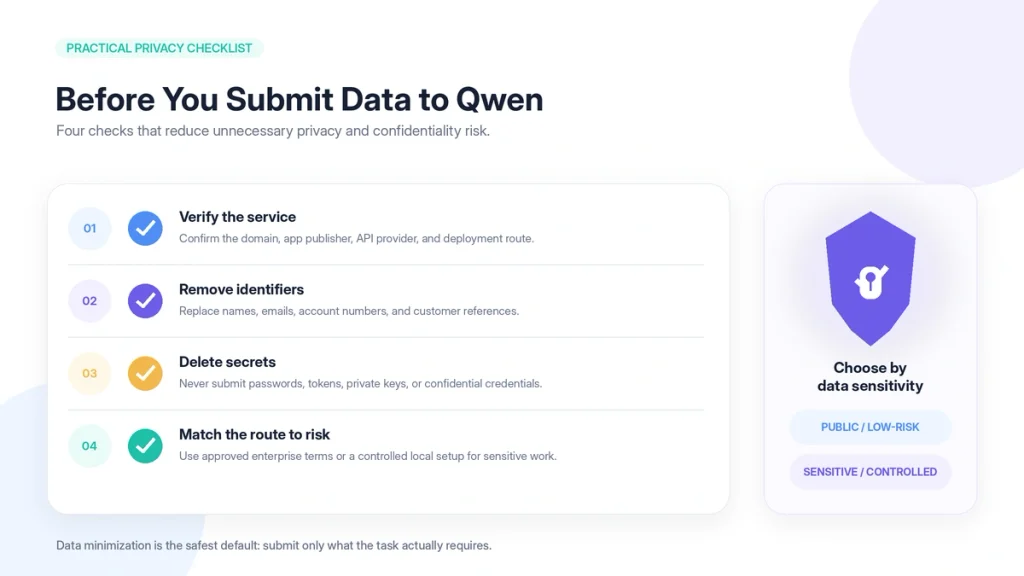
- Verify the service. Confirm the domain, app publisher, provider, account type, and region before entering data.
- Classify the information. Separate public, internal, confidential, regulated, and secret data before choosing a deployment.
- Minimize prompts. Include only the text required to complete the task.
- Redact identifiers. Replace names, emails, phone numbers, IDs, account numbers, and customer references with neutral placeholders.
- Remove secrets. Never submit passwords, API keys, private keys, access tokens, recovery codes, or database credentials.
- Clean files. Remove hidden metadata, comments, tracked changes, internal URLs, and unnecessary pages before upload.
- Protect third parties. Obtain the required rights or consent before uploading another person’s data, face, voice, work, or records.
- Use feedback carefully. Remember that rating an answer can store the related conversation as feedback.
- Review Memory. Remove persistent personal details through available controls and avoid storing sensitive facts.
- Limit cookies. Reject non-essential cookies when they are not needed.
- Choose the correct route. Use an approved enterprise contract or controlled local deployment for higher-risk data.
- Re-check policies. Record the policy version and review it after material product or legal updates.
Is Qwen Private Enough for Your Use Case?
| Use case | Practical assessment | Recommended approach |
|---|---|---|
| Public research, brainstorming, or generic writing | Usually lower risk if no personal or confidential data is included. | Qwen Studio can be used with normal account and cookie precautions. |
| Personal but non-sensitive questions | Moderate privacy exposure because prompts, logs, and account data may be processed. | Remove unnecessary identifiers and avoid enabling persistent memory for sensitive details. |
| Internal business information | Risk depends on confidentiality, contractual duties, and organizational policy. | Use only after company approval and an appropriate service or contract review. |
| Client-confidential, NDA-protected, or proprietary source code | Consumer Qwen Studio documents do not provide a confidentiality-by-default basis. | Avoid consumer Studio; use an approved enterprise/API arrangement or controlled local deployment. |
| Health, financial, education, biometric, government, or other regulated data | High legal and security sensitivity. | Do not use without a formal privacy, security, legal, and compliance assessment. |
| Maximum data control | Hosted consumer services provide less direct infrastructure control. | Consider a properly secured local or private deployment, while auditing telemetry, tools, logs, access, and network egress. |
Frequently Asked Questions
Does Qwen collect what I type?
Yes. Prompts and other content submitted to Qwen Studio are User Content processed to provide the service. User Content can also include uploaded files, images, audio, and video.
Does Qwen use chats to train its models?
The current privacy policy permits de-identified User Content and Feedback to be used to train and improve Qwen’s services, including AI models. This does not prove that every raw chat is selected, but it means users should not assume their submitted content is excluded from model-improvement processing.
Can I disable Qwen model training in Settings?
We did not verify a dedicated consumer model-improvement switch described in the current published privacy policy. Depending on your jurisdiction, you may be able to object to or restrict processing through a privacy request.
Where does Qwen store user data?
The current policy says relevant personal data is stored or processed in Singapore and Mainland China. It also describes limited remote access by certain group entities under controls.
Does deleting my Qwen account erase everything immediately?
The policy does not promise immediate deletion of every associated record. Some data may be retained when an ongoing legitimate business need or legal reason exists. When no such need remains, Qwen says it will delete or anonymize the data, or isolate it until deletion is possible.
Does a thumbs-up or thumbs-down rating share my conversation?
The policy says the related conversation is stored as part of your feedback when you rate an output. Remove sensitive details before submitting feedback.
Is Alibaba Cloud Model Studio covered by the same policy?
No. Model Studio has separate Alibaba Cloud documentation and product terms. Those terms state that Alibaba Cloud will not use Member Content to develop or improve Model Studio models unless the customer separately consents.
Is running Qwen locally automatically private?
Not automatically. Local inference can keep prompts within your environment, but privacy still depends on the application, telemetry, logs, plugins, web tools, remote embeddings, update systems, user permissions, and network egress.
Can I upload another person’s personal data to Qwen?
You are responsible for having the necessary rights, notices, and consents. This is especially important for facial, voice, biometric, employee, customer, child, medical, or financial data.
Can people under 18 use Qwen Studio?
The privacy policy says the services are not directed to or intended for individuals under 18 and that Qwen does not knowingly collect their personal data. Review the current Usage Policy, parental-consent requirements, and local law for the specific situation.
Final Assessment
Qwen’s current privacy policy provides useful disclosures about the categories of data collected, model-improvement use, international processing, retention principles, recipient categories, and user rights. The clearest privacy concerns for consumer Qwen Studio are the permitted use of de-identified User Content and Feedback for service and model improvement, the absence of a clearly documented universal consumer training toggle, processing in Singapore and Mainland China, non-specific retention periods, and the separate Terms of Service provisions on confidentiality and content licensing.
For public or low-sensitivity work, Qwen Studio can be used more safely through data minimization, redaction, careful feedback use, cookie controls, and regular review of Memory and account data. For confidential, regulated, or business-critical information, evaluate Alibaba Cloud Model Studio under its own contract or use a properly secured local deployment rather than assuming the consumer chatbot provides enterprise privacy protections.
Privacy and Legal Disclaimer
This article is an independent plain-English explanation for general informational purposes and is not legal advice, a data-protection impact assessment, or a substitute for reviewing the current governing documents with qualified legal and security professionals. Privacy rights, lawful bases, retention duties, and contractual obligations vary by jurisdiction and use case. Qwen and Alibaba Cloud may update their policies, terms, product behavior, regions, or controls after the verification date.
Main Sources Used
- Qwen Privacy Policy — official policy for Qwen Studio and services accessible through qwen.ai; last updated May 19, 2026.
- Qwen Terms of Service — official terms covering User Content, confidentiality, licenses, service use, and personal-data responsibilities; last updated May 19, 2026.
- Qwen Cookies Notice — official explanation of cookies and similar technologies.
- Alibaba Cloud Model Studio Security Certifications and Privacy Notice — official Model Studio privacy and encryption statements; last updated May 15, 2026.
- Alibaba Cloud International Website Product Terms of Service — official Model Studio-specific content-processing and model-improvement terms; last updated May 29, 2026.
- Qwen Code Terms of Service and Privacy Notice — official explanation of provider-dependent data handling and optional usage telemetry.
- Platform Policy Wiki: Qwen Chat Privacy Policy History — independent archive used to compare policy wording and earlier versions.
Independence Notice
Try-Qwen-AI.com is an independent Qwen resource and service. It is not affiliated with, endorsed by, or operated by Alibaba Group or the Qwen team.
“`html
Last verified: August 24, 2026
Evidence status: Documentation-Verified + Editorial Analysis
Reviewed by: Try-Qwen-AI.com Editorial Team
Qwen’s current privacy policy says the official Qwen Studio service may collect account details, prompts, uploaded content, feedback, technical logs, usage information, cookies, and feature-specific voice or video data. It also says de-identified User Content and Feedback may be used to train and improve Qwen’s services, including its AI models. Personal data may be stored or processed in Singapore and Mainland China, and the policy does not promise one universal deletion period for every data category.
This explanation focuses on the consumer-facing Qwen Studio service available through qwen.ai. It does not automatically describe Alibaba Cloud Model Studio, Qwen Code configured with another provider, a third-party app offering Qwen models, or a Qwen model you run on your own hardware.
Privacy takeaway: Qwen Studio should not be treated as a zero-data-retention, confidential-by-default workspace. It can be reasonable for low-risk tasks when you minimize the data you submit, but confidential, regulated, credential-bearing, or NDA-protected information requires a different deployment route and a formal review of the applicable contract.
Qwen Privacy Policy in Plain English
| Question | Plain-English answer |
|---|---|
| Does Qwen collect prompts and uploads? | Yes. User Content can include prompts and text, files, images, audio, or video submitted through supported features. |
| Can Qwen use conversations to improve its models? | The policy lists de-identified User Content and Feedback as data that may be used to train and improve the services, including AI models. |
| Does every raw chat definitely become training data? | The published policy does not establish that every raw conversation is selected or copied verbatim into a training set. It also does not disclose the selection rate or full training pipeline. |
| Is there a fixed retention period? | No single period is stated for all data. Retention depends on the purpose, legal requirements, and whether an ongoing legitimate need exists. |
| Where is personal data processed? | The current policy identifies Singapore and Mainland China and describes limited remote access by certain group entities under controls. |
| Is there a dedicated consumer training opt-out switch? | We did not find a dedicated model-improvement toggle described in the current published privacy policy. Depending on your location, you may have a right to object or restrict processing. |
| Does this policy cover local Qwen models? | No. Privacy for a local model depends on your application, network access, telemetry, plugins, storage, logs, and any remote services you connect. |
Which Qwen Service Does This Privacy Policy Cover?
The official policy, last updated May 19, 2026, governs Qwen Studio and other services accessible through qwen.ai. The named service provider is Alibaba Cloud (Singapore) Private Limited. This scope matters because “Qwen” can refer to a hosted chatbot, a cloud developer platform, a coding client, an open-weight model family, or a third-party service.
| How you access Qwen | Primary privacy layer | What to remember |
|---|---|---|
| Official Qwen Studio at qwen.ai | Qwen Privacy Policy, Terms of Service, and Cookies Notice | This is the service analyzed in this article. |
| Alibaba Cloud Model Studio | Alibaba Cloud privacy documents and Model Studio product terms | Its official documentation states that customer content is not used to develop or improve Model Studio models unless the customer separately consents. |
| Qwen Code | Qwen Code settings plus the policy of the selected authentication or API provider | Optional Qwen Code usage telemetry is separate from the prompts processed by the chosen model provider. |
| Self-hosted Qwen model | Your infrastructure, software stack, model license, and connected services | Downloading model weights does not create a connection to Qwen Studio, but the surrounding software may still transmit data. |
| Third-party website or app using Qwen | The third party’s privacy policy and its upstream model provider’s terms | A Qwen model name or Qwen-like domain does not make the service official. |
Before evaluating any privacy claim, verify the exact domain, app publisher, API provider, account type, and deployment method. A promise made for Alibaba Cloud Model Studio should not be copied to Qwen Studio, and a local deployment should not be assumed private if it sends prompts to remote tools or telemetry endpoints.
What Personal Data Does Qwen Collect?
The amount of data collected depends on which features you use. Typing a public question into a new chat exposes less information than uploading a document, enabling Memory, sending voice recordings, signing in through another platform, or submitting detailed feedback.
| Data category | Examples | Why it matters |
|---|---|---|
| Account Information | Name, email address, and information supplied when registering or communicating with Qwen | Links service activity to an account and supports authentication, communications, and account administration. |
| User Content | Prompts, conversation text, files, documents, images, audio, and video submitted through supported features | The content itself may contain personal, confidential, copyrighted, or regulated information. |
| Feedback | Thumbs-up or thumbs-down ratings, written comments, and the related conversation | The policy says the related conversation may be stored as part of feedback. |
| Communication Information | Support requests, messages, contact details, and correspondence content | May be needed to answer requests, investigate problems, or document a dispute. |
| Log Data | IP address, browser or device information, request times, and service interactions | Supports security, diagnostics, fraud prevention, and service operation. |
| Usage Data | Features used, content types, actions, access times, country or timezone indicators, and performance information | Can reveal behavior patterns even when it does not include the full prompt text. |
| Cookies and similar technologies | Session identifiers, preferences, measurement data, and advertising-related identifiers where applicable | Used for core functionality, analytics, preferences, and marketing or advertising functions described in the separate notice. |
| Third-party sign-in data | Profile or authentication information made available by a connected sign-in provider | The exact data depends on the provider and the permissions you authorize. |
| Voice, video, and feature-derived data | Recordings, facial or vocal characteristics, and data generated when speech, voice, or audiovisual features are used | The policy warns that some processing may qualify as biometric information under applicable law. |
Prompts are not the only sensitive input
A seemingly harmless prompt can become sensitive when combined with an account identifier, a document’s hidden metadata, an image of a person, customer records, source code comments, location details, or a conversation history. Files can also contain author names, revision history, embedded objects, internal URLs, and tracked changes that are not obvious in the visible document.
How Does Qwen Use Your Data?
The policy connects different data categories to different purposes and legal bases. The practical meaning is that data submitted to provide a response may also be processed for security, support, service operation, and certain improvement activities.
| Purpose | Examples of data involved | Practical meaning |
|---|---|---|
| Provide and maintain the service | Account Information, User Content, Feedback, logs, usage data, and cookies | Qwen must process a prompt and associated service data to return an answer and operate the account. |
| Personalize the experience | Conversation details and information retained through features such as Memory | Past details may influence future responses when personalization is enabled or available. |
| Prevent abuse and protect systems | User Content, account data, logs, usage data, and cookies | Inputs and activity may be analyzed to detect fraud, policy violations, attacks, or misuse. |
| Provide support and improve reliability | Feedback, logs, usage data, account data, and communications | Data can be used to troubleshoot errors, maintain features, and improve service quality. |
| Train and improve services and AI models | De-identified User Content and Feedback | The policy permits model-improvement use under a legitimate-interests basis. |
| Send marketing communications | Account and communication information | The policy ties this activity to consent where required. |
| Comply with law and protect rights or safety | Potentially all relevant categories | Data may be preserved or disclosed when required for legal, regulatory, safety, or rights-protection purposes. |
Model Improvement: What the Policy Actually Says
The most important clause for many users is the model-improvement purpose. The current Qwen privacy policy identifies de-identified User Content and Feedback as data that may be used to train and improve the accuracy, performance, and quality of the services, including Qwen’s AI models.
This supports a more precise conclusion than either “Qwen never uses chats for training” or “every raw chat is automatically placed into a training dataset.” The published policy permits improvement use, but it does not disclose:
- what percentage of conversations is selected;
- the full de-identification method;
- whether every feature follows the same internal pipeline;
- how long selected improvement data remains in each stage;
- or a dedicated consumer setting that disables this specific use across Qwen Studio.
What “de-identified” does and does not mean
De-identification is intended to reduce the ability to connect content to a person. It should not be read as a promise that the original submission was never associated with an account, IP address, device, or service log before de-identification. It is also different from a contractual promise that no content will be retained or used for improvement.
Feedback can include the related conversation
If you rate an output with the thumbs-up or thumbs-down control, the policy says Qwen will store the related conversation as part of that feedback. Avoid rating a conversation that contains sensitive information unless you have first removed or replaced that information.
Can you opt out?
At the time of verification, we did not find a dedicated in-product consumer switch described in the published privacy policy specifically for stopping model-improvement use. The policy does describe rights that may include objecting to or restricting processing, depending on your jurisdiction. A statutory objection request is not the same as a universal settings toggle, and acceptance can depend on the applicable law and Qwen’s legal grounds for processing.
Memory, Voice, Video, and Biometric-Related Processing
Qwen Memory
The privacy policy says Qwen may provide personalized services through a Memory feature that can retain certain details from conversations. This can make future responses more relevant, but it also creates a persistent privacy surface beyond the current chat.
- Do not give Memory passwords, recovery answers, identity numbers, financial details, medical records, client secrets, or private information about other people.
- Review and remove stored details through available account controls when the feature provides them.
- Do not assume deleting one visible chat automatically removes every separately stored memory or legally retained record.
Voice and video features
When you use voice, speech, audio, image, or video features, Qwen may process recordings and characteristics associated with a face or voice. The policy notes that this processing may be considered biometric information under applicable laws. The Terms of Service also place responsibility on users to obtain the necessary rights and consents before uploading another person’s facial, voice, or biometric data.
For sensitive recordings, interviews, employee calls, customer media, children’s content, or identity documents, obtain an appropriate legal and organizational review before uploading anything.
Where Is Qwen Data Stored and Processed?
The current Qwen privacy policy says the relevant personal data is stored or processed in Singapore and Mainland China. It also says certain corporate-group entities in those locations receive limited remote access where necessary, subject to security controls and authorization procedures.
For international transfers, the policy explains that privacy laws may differ between jurisdictions and describes transfer mechanisms used where applicable, including adequacy decisions and standard contractual clauses for certain transfers involving the European Economic Area, United Kingdom, or Switzerland.
Avoid two inaccurate shortcuts: “All Qwen data stays in my country” is not supported by the consumer policy, while “all Qwen data is stored only in China” is also inconsistent with the current disclosure naming both Singapore and Mainland China.
Data location is an important governance factor, but it does not by itself prove that a service is secure or insecure. A complete assessment also examines the contract, access controls, encryption, incident response, retention, subprocessors, employee access, regulatory obligations, and the sensitivity of the submitted content.
Who Can Receive Qwen Data?
The policy describes several categories of recipients that may receive personal data when relevant:
- Alibaba group companies, affiliates, and designated service providers involved in delivering the service;
- third-party service providers and partners that process data for the purposes described in the policy;
- analytics, search-engine, and other providers that help deliver, improve, or optimize services;
- prospective or completed investors, assignees, buyers, or transferees involved in a corporate transaction;
- courts, regulators, government agencies, law-enforcement bodies, professional advisers, or other parties when disclosure is legally necessary;
- and other recipients when you consent to the disclosure.
Third-party products reached through a search result, external link, plugin, or integrated service can have separate policies. Review those policies before sending data because Qwen’s consumer privacy policy does not control an independently operated third party.
How Long Does Qwen Keep Your Data?
Qwen does not publish one universal retention period covering every prompt, file, account record, security log, feedback item, cookie, and legal record. The policy says personal data is retained while there is an ongoing legitimate need or legal reason to process it. When that need ends, Qwen says it will securely delete or anonymize the data, or securely store and isolate it if immediate deletion is not possible.
The actual period can vary because different records support different purposes. Account administration, security investigations, fraud prevention, dispute resolution, tax or accounting requirements, legal claims, and regulatory duties may justify different retention windows.
What Happens When You Delete a Chat or Account?
Deleting a visible conversation, disabling a feature, deleting an account, and submitting a formal privacy request are different actions. Do not assume that one action instantly removes every copy from operational systems, backups, security records, feedback records, improvement datasets, or records retained for legal reasons.
- Deleting a chat may remove it from your visible history, but the public policy does not provide a universal immediate-erasure guarantee for every associated record.
- Deleting an account ends normal account access, but the policy allows continued retention in some circumstances.
- Submitting an erasure request invokes applicable privacy rights, but exceptions may apply when retention is legally required or otherwise permitted.
Before deleting an account, export or save any content you are permitted to keep. After making a privacy request, retain the confirmation and correspondence for your records.
Qwen Cookies and Advertising Technologies
Qwen publishes a separate Cookies Notice. It describes first-party and third-party technologies, session and persistent cookies, strictly necessary cookies, and advertising or measurement cookies. Necessary cookies support core functions such as security, authentication, and preference storage, while non-essential technologies can support analytics, campaign measurement, or personalized advertising.
Use the Manage Cookies control on the official Qwen site to review available choices. Cookie preferences can be specific to a browser or device, so repeat the review when you change browsers, clear storage, use another device, or create a separate browser profile.
- Reject non-essential cookies when they are unnecessary for your use case.
- Remember that blocking browser cookies does not change how submitted prompts are processed on Qwen’s servers.
- Review the Cookies Notice again after major policy or product updates.
Your Qwen Privacy Rights
The rights available to you depend on your country or region. The current policy lists rights that may include:
- accessing your personal data and information about its processing;
- requesting erasure or deletion;
- updating or correcting inaccurate data;
- requesting data portability;
- restricting or objecting to certain processing;
- withdrawing consent where processing relies on consent;
- and complaining to a competent data-protection authority.
Qwen’s published privacy contact is [email protected]. Withdrawing consent can affect Qwen’s ability to provide a feature when the requested processing is necessary for that feature. Qwen may also need to verify your identity before completing a request.
How to write a clearer privacy request
- Send the request from the email address associated with your Qwen account when possible.
- State that your request concerns Qwen Studio or services accessed through
qwen.ai. - Identify your country or region because applicable rights differ.
- Specify the action requested: access, correction, deletion, portability, restriction, or objection.
- Describe the account or data scope precisely without including passwords, API keys, or unnecessary identity documents.
- Keep a copy of the request, delivery evidence, and any response.
Children and Minors
The Qwen privacy policy states that the services are not directed to or intended for individuals under 18 and that Qwen does not knowingly collect personal data from minors. Separately, Qwen’s Usage Policy contains age and parental-consent language. Parents, schools, and guardians should review the currently applicable documents and local law rather than relying on a general-purpose AI account for unsupervised use by a child.
The Privacy Policy Is Not the Same as the Terms of Service
The Privacy Policy explains how personal data is collected and processed. The Terms of Service govern contractual rights, responsibilities, confidentiality, content licensing, and permitted use. You need to read both before submitting valuable or sensitive material.
Qwen’s current Terms say that Qwen has no confidentiality obligation regarding User Content unless a separate direct contract says otherwise or applicable law requires it. The Terms also grant Qwen and its affiliates a broad license over User Content and authorize certain uses of non-personal User Content to develop and improve machine-learning and AI technologies.
The same Terms say users retain the rights they have in their prompts and that Qwen assigns to users its rights, if any, in generated outputs, subject to the Terms. Those ownership statements do not cancel the separate license or confidentiality clauses.
Operational rule: Do not paste trade secrets, unreleased product plans, private repositories, client documents, passwords, personal records, or NDA-protected material into consumer Qwen Studio based only on the assumption that a chat interface is confidential.
Qwen Studio vs Model Studio, Qwen Code, and Local Qwen
| Route | Published data-use position | Privacy decision |
|---|---|---|
| Qwen Studio consumer service | Policy permits de-identified User Content and Feedback to improve services and AI models. | Use data minimization; do not assume confidentiality or zero retention. |
| Alibaba Cloud Model Studio | Official Model Studio documentation says customer data is not used for model training, and product terms say Member Content is not used to develop or improve models unless the customer separately consents. | Potentially more suitable for governed workloads, but review the contract, region, DPA, model provider, logging, retention, and configuration. |
| Qwen Code with Qwen OAuth or Alibaba Cloud | Optional usage telemetry can be controlled in Qwen Code, while prompt handling follows the selected provider’s policy. | Disable optional telemetry when appropriate and review the provider separately. |
| Qwen Code with another API provider | The third-party API provider determines prompt retention and training use. | Read that provider’s terms; the Qwen model name does not determine the data policy. |
| Self-hosted Qwen model | No Qwen Studio privacy policy is automatically applied to local inference. | Can provide stronger control when the deployment is isolated, access-controlled, patched, monitored, and free of unintended remote transmission. |
Alibaba Cloud Model Studio’s current privacy documentation also states that data transmitted during application building and model training is encrypted with AES-256. That statement belongs to Model Studio documentation and should not be presented as a blanket promise for every Qwen-branded service or third-party deployment.
Practical Privacy Checklist Before Using Qwen
- Verify the service. Confirm the domain, app publisher, provider, account type, and region before entering data.
- Classify the information. Separate public, internal, confidential, regulated, and secret data before choosing a deployment.
- Minimize prompts. Include only the text required to complete the task.
- Redact identifiers. Replace names, emails, phone numbers, IDs, account numbers, and customer references with neutral placeholders.
- Remove secrets. Never submit passwords, API keys, private keys, access tokens, recovery codes, or database credentials.
- Clean files. Remove hidden metadata, comments, tracked changes, internal URLs, and unnecessary pages before upload.
- Protect third parties. Obtain the required rights or consent before uploading another person’s data, face, voice, work, or records.
- Use feedback carefully. Remember that rating an answer can store the related conversation as feedback.
- Review Memory. Remove persistent personal details through available controls and avoid storing sensitive facts.
- Limit cookies. Reject non-essential cookies when they are not needed.
- Choose the correct route. Use an approved enterprise contract or controlled local deployment for higher-risk data.
- Re-check policies. Record the policy version and review it after material product or legal updates.
Is Qwen Private Enough for Your Use Case?
| Use case | Practical assessment | Recommended approach |
|---|---|---|
| Public research, brainstorming, or generic writing | Usually lower risk if no personal or confidential data is included. | Qwen Studio can be used with normal account and cookie precautions. |
| Personal but non-sensitive questions | Moderate privacy exposure because prompts, logs, and account data may be processed. | Remove unnecessary identifiers and avoid enabling persistent memory for sensitive details. |
| Internal business information | Risk depends on confidentiality, contractual duties, and organizational policy. | Use only after company approval and an appropriate service or contract review. |
| Client-confidential, NDA-protected, or proprietary source code | Consumer Qwen Studio documents do not provide a confidentiality-by-default basis. | Avoid consumer Studio; use an approved enterprise/API arrangement or controlled local deployment. |
| Health, financial, education, biometric, government, or other regulated data | High legal and security sensitivity. | Do not use without a formal privacy, security, legal, and compliance assessment. |
| Maximum data control | Hosted consumer services provide less direct infrastructure control. | Consider a properly secured local or private deployment, while auditing telemetry, tools, logs, access, and network egress. |
Frequently Asked Questions
Does Qwen collect what I type?
Yes. Prompts and other content submitted to Qwen Studio are User Content processed to provide the service. User Content can also include uploaded files, images, audio, and video.
Does Qwen use chats to train its models?
The current privacy policy permits de-identified User Content and Feedback to be used to train and improve Qwen’s services, including AI models. This does not prove that every raw chat is selected, but it means users should not assume their submitted content is excluded from model-improvement processing.
Can I disable Qwen model training in Settings?
We did not verify a dedicated consumer model-improvement switch described in the current published privacy policy. Depending on your jurisdiction, you may be able to object to or restrict processing through a privacy request.
Where does Qwen store user data?
The current policy says relevant personal data is stored or processed in Singapore and Mainland China. It also describes limited remote access by certain group entities under controls.
Does deleting my Qwen account erase everything immediately?
The policy does not promise immediate deletion of every associated record. Some data may be retained when an ongoing legitimate business need or legal reason exists. When no such need remains, Qwen says it will delete or anonymize the data, or isolate it until deletion is possible.
Does a thumbs-up or thumbs-down rating share my conversation?
The policy says the related conversation is stored as part of your feedback when you rate an output. Remove sensitive details before submitting feedback.
Is Alibaba Cloud Model Studio covered by the same policy?
No. Model Studio has separate Alibaba Cloud documentation and product terms. Those terms state that Alibaba Cloud will not use Member Content to develop or improve Model Studio models unless the customer separately consents.
Is running Qwen locally automatically private?
Not automatically. Local inference can keep prompts within your environment, but privacy still depends on the application, telemetry, logs, plugins, web tools, remote embeddings, update systems, user permissions, and network egress.
Can I upload another person’s personal data to Qwen?
You are responsible for having the necessary rights, notices, and consents. This is especially important for facial, voice, biometric, employee, customer, child, medical, or financial data.
Can people under 18 use Qwen Studio?
The privacy policy says the services are not directed to or intended for individuals under 18 and that Qwen does not knowingly collect their personal data. Review the current Usage Policy, parental-consent requirements, and local law for the specific situation.
Final Assessment
Qwen’s current privacy policy provides useful disclosures about the categories of data collected, model-improvement use, international processing, retention principles, recipient categories, and user rights. The clearest privacy concerns for consumer Qwen Studio are the permitted use of de-identified User Content and Feedback for service and model improvement, the absence of a clearly documented universal consumer training toggle, processing in Singapore and Mainland China, non-specific retention periods, and the separate Terms of Service provisions on confidentiality and content licensing.
For public or low-sensitivity work, Qwen Studio can be used more safely through data minimization, redaction, careful feedback use, cookie controls, and regular review of Memory and account data. For confidential, regulated, or business-critical information, evaluate Alibaba Cloud Model Studio under its own contract or use a properly secured local deployment rather than assuming the consumer chatbot provides enterprise privacy protections.
Privacy and Legal Disclaimer
This article is an independent plain-English explanation for general informational purposes and is not legal advice, a data-protection impact assessment, or a substitute for reviewing the current governing documents with qualified legal and security professionals. Privacy rights, lawful bases, retention duties, and contractual obligations vary by jurisdiction and use case. Qwen and Alibaba Cloud may update their policies, terms, product behavior, regions, or controls after the verification date.
Main Sources Used
- Qwen Privacy Policy — official policy for Qwen Studio and services accessible through qwen.ai; last updated May 19, 2026.
- Qwen Terms of Service — official terms covering User Content, confidentiality, licenses, service use, and personal-data responsibilities; last updated May 19, 2026.
- Qwen Cookies Notice — official explanation of cookies and similar technologies.
- Alibaba Cloud Model Studio Security Certifications and Privacy Notice — official Model Studio privacy and encryption statements; last updated May 15, 2026.
- Alibaba Cloud International Website Product Terms of Service — official Model Studio-specific content-processing and model-improvement terms; last updated May 29, 2026.
- Qwen Code Terms of Service and Privacy Notice — official explanation of provider-dependent data handling and optional usage telemetry.
- Platform Policy Wiki: Qwen Chat Privacy Policy History — independent archive used to compare policy wording and earlier versions.
Independence Notice
Try-Qwen-AI.com is an independent Qwen resource and service. It is not affiliated with, endorsed by, or operated by Alibaba Group or the Qwen team.
Last verified: August 24, 2026
Evidence status: Documentation-Verified + Editorial Analysis
Reviewed by: Try-Qwen-AI.com Editorial Team