
Qwen is best described as a mixed open-weight ecosystem, not a single model family governed by one universal license. Many downloadable Qwen models are published under the permissive Apache License 2.0 and can generally be used in commercial products. However, important exceptions use custom Qwen licenses with research-only restrictions, attribution duties, user thresholds, revenue thresholds, or separate-license requirements.
The safest rule is simple: check the complete LICENSE file distributed with the exact Qwen model repository and revision you plan to use. Do not infer a checkpoint’s license from the Qwen family name, model size, GitHub repository, API provider, or another model in the same generation.
Legal note: This guide explains publicly available license documents for practical comparison. It is not legal advice. Organizations making material commercial, regulatory, or intellectual-property decisions should have the applicable license reviewed by qualified legal counsel.
Is Qwen Open Source?
The accurate answer is more nuanced than a simple yes or no.
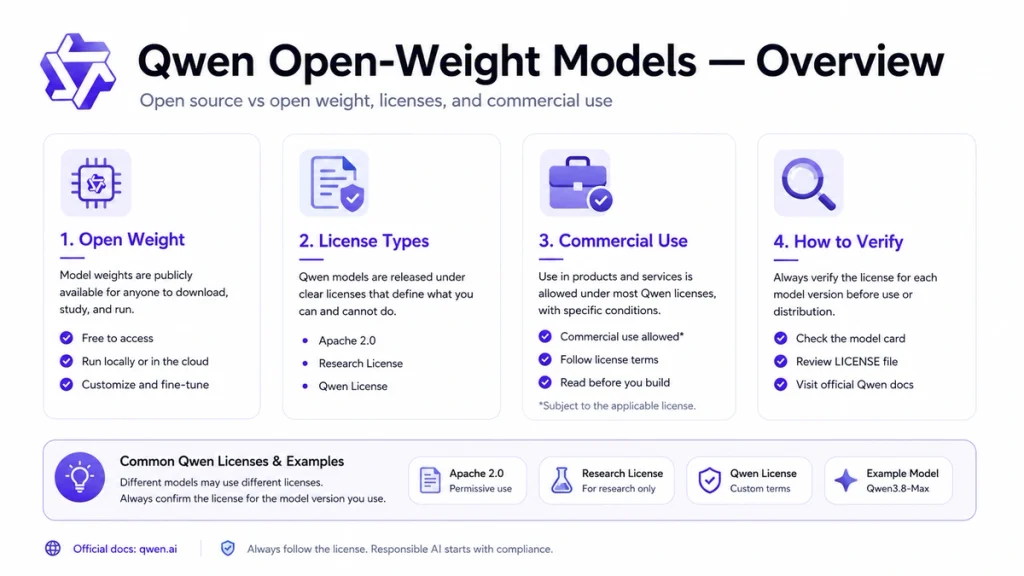
Qwen includes downloadable model weights, open-source code repositories, custom-licensed checkpoints, hosted APIs, and consumer-facing services. Many Qwen checkpoints can be downloaded, self-hosted, fine-tuned, quantized, and deployed on infrastructure controlled by the user. That makes open weight the most precise description for many Qwen model releases.
Calling the entire Qwen ecosystem “open source” can be misleading because it may imply that the complete training data, data-processing pipeline, training code, model weights, and all related services are available under the same open-source terms. They are not.
The Open Source Initiative’s Open Source AI Definition treats an open-source AI system as more than a downloadable checkpoint. Its definition considers the information and components needed to use, study, modify, and share the system, including relevant data information, code, and model parameters.
Therefore, a useful practical answer is:
- Many Qwen models are open weight.
- Many official Qwen repositories use recognized open-source software licenses such as Apache 2.0.
- Some Qwen checkpoints use custom licenses rather than Apache 2.0.
- Qwen Studio and hosted APIs are services governed by separate service terms.
- Public access to a model does not automatically mean unrestricted commercial use.
Qwen Open Source vs Qwen Open Weight
The terms open source and open weight are frequently used as though they mean the same thing, but they answer different questions.
| Term | What it usually means | What it does not automatically prove |
|---|---|---|
| Open weight | The trained model parameters are available for download under stated terms. | That the full training dataset, preprocessing pipeline, training code, or exact reproduction process is available. |
| Open-source code | A software repository is distributed under an open-source software license. | That every model weight linked from the repository uses the same license. |
| Open-source AI | A broader claim involving the freedom and materials needed to use, study, modify, and share an AI system. | That publishing final weights alone satisfies every definition of open-source AI. |
| Public API | A hosted model can be accessed through an endpoint. | That users can download, modify, or redistribute the underlying weights. |
| Free web access | A model or product may be usable without an immediate payment. | That the underlying model is open weight or licensed for every commercial purpose. |
With an open-weight Qwen model, a developer may be able to download the checkpoint, run local inference, create a quantized version, fine-tune it, and serve it through a private endpoint. Whether each action is legally permitted still depends on the exact license attached to that checkpoint.
Why There Is No Single Qwen License
A Qwen deployment can involve several separate legal layers. Reviewing only one layer can produce the wrong answer.
1. Repository Code License
A GitHub repository may contain inference examples, configuration files, documentation, deployment instructions, evaluation scripts, or fine-tuning utilities. The repository can use Apache 2.0 even when an individual model linked from it uses a different weight license.
This distinction is visible in the official Qwen3.8 GitHub repository. The repository has its own software license, while its licensing section instructs users to check the license file distributed with each model’s weights on Hugging Face or ModelScope.
2. Model-Weight License
The model repository’s LICENSE file is the critical document when you plan to:
- Download and self-host a Qwen model.
- Fine-tune or modify its parameters.
- Create a LoRA adapter.
- Convert the checkpoint to GGUF, AWQ, GPTQ, FP8, INT8, or another format.
- Redistribute the original or modified weights.
- Sell access to a self-hosted deployment.
- Use the model inside a commercial product.
- Use model outputs to train or improve another AI model.
The license label shown in a model card is a useful starting point, but it should not replace reading the complete LICENSE file and any accompanying NOTICE, acceptable-use, or responsible-use documents.
3. Hosted-Service and API Terms
Qwen Studio, Alibaba Cloud Model Studio, Qwen Cloud, an official Qwen API, or a third-party inference provider may impose terms that are separate from the downloadable model license.
Hosted-service terms may cover:
- Permitted commercial activities.
- Account eligibility and regional availability.
- Prompt and output retention.
- Whether submitted data may be used for service improvement or training.
- Rate limits and usage quotas.
- Model aliases and deprecation rules.
- Acceptable-use restrictions.
- Warranty, indemnity, and liability terms.
A provider stating that commercial API use is allowed does not automatically replace or reinterpret the license attached to downloadable Qwen weights.
Current Qwen Model License Map
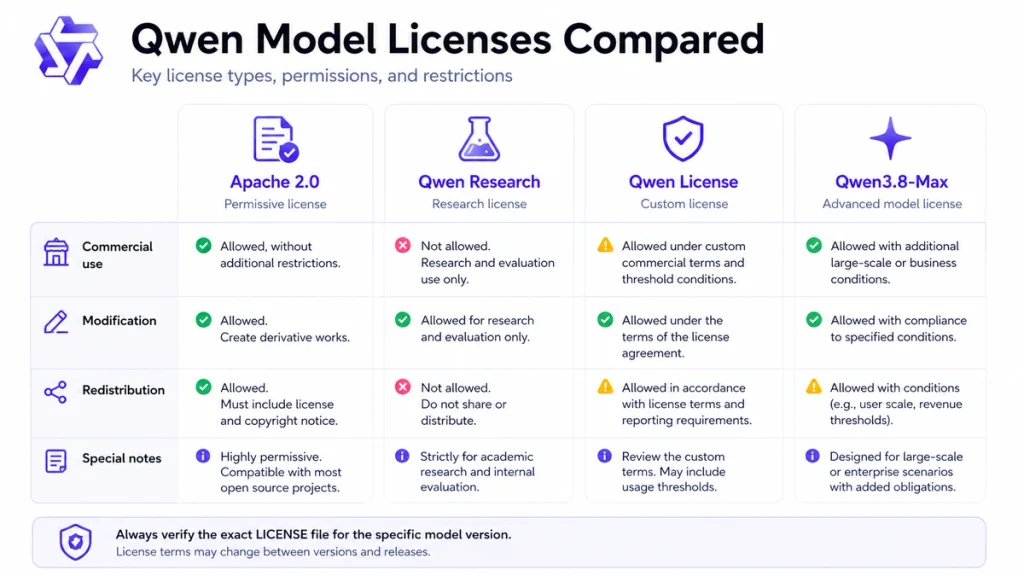
The following table summarizes important official Qwen licensing patterns verified on August 24, 2026. It is a practical reference, not a substitute for inspecting the exact repository and revision used in your deployment.
| Model or family | Published license | Commercial use | Important point |
|---|---|---|---|
| Qwen3.8-27B | Apache 2.0 | Generally permitted | The official checkpoint contains the standard Apache License 2.0. |
| Qwen3.8-2.4T-A95B | Qwen3.8-Max License | Permitted subject to custom conditions | Includes product-scale attribution and separate-license conditions for certain large MaaS and AI Work Assistant businesses. |
| Original Qwen3 open-weight family | Apache 2.0 | Generally permitted | The official Qwen3 repository states that its open-weight models use Apache 2.0. |
| Qwen3.5-397B-A17B | Apache 2.0 | Generally permitted | The official model repository checked for this checkpoint contains Apache 2.0. |
| Qwen3.6-27B | Apache 2.0 | Generally permitted | The official model repository contains Apache 2.0. |
| Qwen3.6-35B-A3B | Apache 2.0 | Generally permitted | The official model repository contains Apache 2.0. |
| Qwen2.5 general-purpose 0.5B, 1.5B, 7B, 14B, and 32B | Apache 2.0 | Generally permitted | The official Qwen2.5 LLM release identifies 3B and 72B as the important exceptions. |
| Qwen2.5-3B and Qwen2.5-3B-Instruct | Qwen Research License | Not under the default license | The standard grant is limited to research or evaluation; commercial use requires a separate license. |
| Qwen2.5-72B and Qwen2.5-72B-Instruct | Qwen License Agreement | Permitted subject to custom conditions | A separate license is required when the commercially using product or service exceeds 100 million monthly active users. |
| Qwen2 0.5B, 1.5B, 7B, and 57B-A14B | Apache 2.0 | Generally permitted | The official Qwen2 announcement moved these sizes to Apache 2.0. |
| Qwen2-72B and Qwen2-72B-Instruct | Tongyi Qianwen License Agreement | Permitted subject to custom restrictions | Includes a 100-million-MAU threshold and a restriction on using the model or its outputs to improve another LLM, except Qwen derivatives. |
| API-only or Studio-only models | Service terms | Depends on service and plan | Access to a hosted model does not grant a right to copy or redistribute its weights. |
The official source documents behind this map include the Qwen3.8-27B license, the Qwen3.8-2.4T-A95B license, the official Qwen3 repository, and the official Qwen2.5 LLM release.
This table also demonstrates why parameter count is not a reliable licensing rule. Qwen3.5-397B-A17B is published under Apache 2.0, while the much smaller Qwen2.5-3B uses a research-only license. The exact Model ID controls the answer.
Can You Use Qwen Commercially?
Yes, many Qwen models can be used commercially. The exact answer depends on the license attached to the chosen checkpoint.
- Apache 2.0: Commercial use is generally permitted, including use, modification, hosting, and redistribution, subject to the license conditions.
- Qwen3.8-Max License: Commercial use is broadly granted, but special attribution and separate-license conditions can apply at defined revenue, user, and business-type thresholds.
- Qwen Research License: The default grant is limited to research or evaluation. Commercial use requires a separate license.
- Qwen License Agreement: Commercial use is permitted under its conditions, but a separate license is required after the stated monthly-active-user threshold.
- Tongyi Qianwen License Agreement: Commercial use is subject to custom requirements, including a user threshold and restrictions related to improving other language models.
- Hosted APIs and Qwen Studio: Commercial use depends on the service’s current terms, plan, provider, model, and region.
“Free to download” and “free for commercial use” are not equivalent. A model can be publicly downloadable without charge while still restricting paid products, external services, redistribution, or downstream model training.
What Apache License 2.0 Allows
Apache License 2.0 grants broad rights to reproduce, modify, create derivative works, publicly display, sublicense, and distribute the covered work. It also includes an express patent-license grant from contributors for applicable patent claims.
For an official Qwen checkpoint distributed under Apache 2.0, the license generally supports activities such as:
- Using the model for internal company workloads.
- Running the model inside a commercial web or mobile application.
- Hosting inference behind a private or public API.
- Fine-tuning the model using proprietary datasets.
- Building a closed-source application around the model.
- Creating and publishing modified checkpoints.
- Producing and distributing quantized versions.
- Charging customers for a product or service powered by the model.
- Offering paid hosting, integration, support, or consulting services.
Using an Apache-licensed Qwen model does not normally require the rest of your application to become open source. However, redistribution of the covered checkpoint or a derivative must comply with the Apache license’s continuing requirements.
The complete license text is available from the Apache Software Foundation.
Apache 2.0 Obligations for Qwen Models
Apache 2.0 is permissive, but it is not a public-domain dedication with no conditions.
When redistributing an Apache-licensed Qwen checkpoint or a derivative, you should generally:
- Give recipients a copy of the Apache License 2.0.
- Place prominent notices on files that you materially changed.
- Retain relevant copyright, patent, trademark, and attribution notices.
- Reproduce applicable attribution information when the original distribution contains a NOTICE file.
- Avoid implying that your product is operated, endorsed, or supported by Qwen or Alibaba.
- Avoid presenting warranties or liabilities as though they were provided by the original contributors.
Apache 2.0 does not grant a general trademark license. You may usually identify the model’s origin in a reasonable and descriptive manner, but using Qwen branding in a way that suggests official affiliation is a separate legal and branding issue.
Do Apache-Licensed Qwen Models Require a “Powered by Qwen” Badge?
Apache 2.0 does not ordinarily require a public-facing “Powered by Qwen” badge merely because an application uses an Apache-licensed checkpoint.
You may still need to preserve license and attribution notices when distributing the model or a derivative. A separate user-interface attribution requirement can also arise under a custom Qwen license, particularly the Qwen3.8-Max License at its stated scale thresholds.
Qwen3.8-Max License Explained
Qwen3.8 introduced an important licensing split between its two initial open-weight checkpoints:
- Qwen3.8-27B: Apache License 2.0.
- Qwen3.8-2.4T-A95B: Custom Qwen3.8-Max License.
The Qwen3.8-Max License grants broad rights to use, copy, modify, merge, publish, distribute, sublicense, sell, deploy, host, fine-tune, and create derivative works from the included software and model weights. It is not a research-only license.
However, it adds conditions that do not appear in the standard Apache 2.0 license.
Copyright and Permission Notice
The copyright and permission notice must be included in copies or substantial portions of the software covered by the license.
Large-Product User-Interface Attribution
If the model or a derivative is used in a commercial product or service that exceeds either of the following thresholds, the relevant model name must be prominently displayed in the product or service’s user interface:
- More than 100 million monthly active users; or
- More than US$20 million in monthly revenue.
This condition creates a public attribution obligation. It should not be confused with the separate-license trigger described next.
MaaS and AI Work Assistant Separate-License Trigger
A separate Qwen license is required before commercial use when all of the following conditions are met:
- The licensee or one of its affiliates conducts a defined Model as a Service or AI Work Assistant business.
- The aggregate revenue of the licensee and its affiliates exceeds US$50 million during any consecutive 12-month period.
- The Qwen3.8-2.4T-A95B software or a derivative will be used for a commercial purpose.
The license defines Model as a Service as providing third parties with access to model inference or fine-tuning in a way that gives those third parties meaningful control over inputs, parameters, or training data, such as through an API or hosted endpoint.
It defines an AI Work Assistant as an independent AI-powered product primarily designed for AI-assisted coding or office productivity. The definition excludes certain single-purpose tools, assistants focused on other domains, and AI features inside products whose primary purpose is not coding or office productivity.
Internal-Use Exception
The special MaaS and AI Work Assistant separate-license requirement does not apply to internal use when the software, its outputs, and its underlying model capabilities are not made available to third parties.
This means the license analysis can differ between:
- An internal assistant used only by a company’s employees.
- A public coding assistant offered to external customers.
- A hosted inference endpoint exposed to outside developers.
- A single-purpose translation tool powered by the model.
Do Not Merge the Qwen3.8-Max Thresholds
| Test | Trigger | Consequence |
|---|---|---|
| Product-scale test | More than 100 million MAU or more than US$20 million in monthly product or service revenue | The relevant model name must be prominently displayed in the user interface. |
| Business-type test | A defined MaaS or AI Work Assistant business with more than US$50 million aggregate revenue during a consecutive 12-month period | A separate Qwen license is required before commercial use, subject to the internal-use exception. |
Qwen3.8-2.4T-A95B is therefore commercially usable under broad published rights, but it is not legally interchangeable with an Apache-licensed Qwen checkpoint.
Qwen Research License Explained
The official Qwen2.5-3B license is the Qwen Research License Agreement.
It defines non-commercial use as use for research or evaluation purposes only. The standard grant permits use, reproduction, distribution, modification, and derivative works for non-commercial purposes only. A user who wants to use the covered materials commercially must request a separate license.
The agreement also requires, among other things:
- Providing recipients with a copy of the research license.
- Marking modified files.
- Retaining the specified Qwen notice when distributing the materials.
- Complying with applicable export-control laws and regulations.
- Displaying “Built with Qwen” or “Improved using Qwen” in product documentation when the materials or their outputs are used to create, train, fine-tune, or improve an AI model that is distributed or made available.
Qwen2.5-3B should therefore not be placed in a paid app, commercial SaaS product, or customer-facing business deployment merely because its weights are publicly downloadable.
This exception is easy to miss because nearby Qwen2.5 sizes such as 1.5B and 7B use Apache 2.0.
Qwen License Agreement for Qwen2.5-72B
Qwen2.5-72B and Qwen2.5-72B-Instruct use the custom Qwen License Agreement, rather than Apache 2.0 or the research-only agreement.
The agreement grants rights to use, reproduce, distribute, copy, modify, and create derivative works from the covered materials. It also allows the materials or their derivatives to be made available as part of products and services, subject to the agreement’s conditions.
Important conditions include:
- Providing recipients with a copy of the agreement.
- Marking modified files.
- Retaining the required Qwen attribution notice in distributed copies.
- Requesting a separate license when a commercially using product or service exceeds 100 million monthly active users.
- Displaying “Built with Qwen” or “Improved using Qwen” when the materials or their outputs are used to create or improve an AI model that is distributed or made available.
A commercial startup below the 100-million-MAU threshold is not automatically prohibited from using Qwen2.5-72B. It must still comply with the complete agreement, and its licensing position must be reviewed again before crossing the threshold.
Older Tongyi Qianwen License Restrictions
Qwen2-72B and Qwen2-72B-Instruct use the older Tongyi Qianwen License Agreement.
The agreement grants rights to use, modify, and distribute the materials, but includes custom conditions. A separate license is required when a commercially using product or service exceeds 100 million monthly active users.
It also states that the materials or their outputs cannot be used to improve another large language model, excluding Tongyi Qianwen or its derivative works.
This condition is more restrictive than the standard Apache 2.0 license and differs from the wording used in the later Qwen2.5 custom agreement.
Do not apply a Qwen3 or Qwen2.5 license interpretation retroactively to an older Qwen2 checkpoint.
Qwen Commercial-Use Scenarios
The following table provides a practical first-pass analysis. It does not replace a complete legal review.
| Scenario | Likely answer | What to verify |
|---|---|---|
| Use Qwen3.8-27B in an internal RAG system | Generally permitted | Apache compliance, dataset rights, security controls, and third-party libraries. |
| Sell a SaaS app powered by an Apache-licensed Qwen model | Generally permitted | License notices, trademark presentation, user-data terms, and the licenses of other components. |
| Host an Apache-licensed Qwen checkpoint behind a paid API | Generally permitted | Apache obligations, local laws, model safety, and customer terms. |
| Fine-tune an Apache-licensed Qwen model using proprietary data | Generally permitted | Your rights to use the training data and your obligations if the derivative is distributed. |
| Sell or publish the fine-tuned Apache checkpoint | Generally permitted | Include the license, preserve notices, and mark material modifications. |
| Use Qwen2.5-3B in a paid mobile app | Not under the default research license | Obtain a separate commercial license. |
| Use Qwen2.5-72B in a commercial product below 100 million MAU | Permitted under the custom agreement, subject to all conditions | Attribution, redistribution, downstream-model use, and future growth. |
| Continue commercial Qwen2.5-72B use after exceeding 100 million MAU | Separate authorization required | Contact the licensor before crossing the threshold. |
| Use Qwen3.8-2.4T-A95B in a product earning more than US$20 million per month | Permitted subject to the custom license | Display the model name and determine whether the separate-license rule also applies. |
| Operate a public Qwen3.8-based MaaS business with more than US$50 million aggregate 12-month revenue | Separate Qwen license required | Business definition, affiliate revenue, deployment architecture, and the internal-use exception. |
| Use Qwen3.8-2.4T-A95B only in a private internal assistant | The special MaaS or work-assistant trigger may not apply | Ensure that the model, outputs, and capabilities are not made available to third parties. |
| Call Qwen through an official or third-party API | Depends on the service | Provider terms, model identity, data policy, region, retention, and commercial plan. |
| Download a community Qwen GGUF conversion | Not enough information from the GGUF label alone | Verify both the original Qwen checkpoint and the community repository. |
Fine-Tuning Qwen Models
Fine-tuning does not create a licensing reset. A derivative model remains connected to the rights and conditions attached to its base checkpoint.
Before fine-tuning a Qwen model, record:
- The exact base Model ID.
- The official repository owner.
- The repository revision or commit hash.
- The LICENSE file stored at that revision.
- The model-card version and download date.
- The fine-tuning framework and method.
- The datasets and their licenses or contractual restrictions.
- Whether the result will remain internal, be hosted, or be redistributed.
- Any attribution, NOTICE, or documentation requirements.
Apache 2.0 grants broad derivative-work rights subject to its conditions. Custom Qwen licenses may also permit modification and fine-tuning, but their additional conditions continue to apply to the covered materials and relevant derivatives.
LoRA and Adapter Licenses
A LoRA adapter may be distributed separately from the complete base checkpoint, but that does not make the base model’s license irrelevant.
A responsible adapter release should identify:
- The required base model.
- The exact base-model revision.
- The base-model license.
- The adapter’s own license.
- Any required attribution.
- Whether merged weights are also being distributed.
A person combining the adapter with the base model needs sufficient rights for both components.
Quantization Does Not Replace the Original License
Converting a Qwen checkpoint to GGUF, AWQ, GPTQ, FP8, INT8, INT4, or another representation does not automatically replace the upstream model license.
Before using or distributing a quantized Qwen model, check:
- The official base model’s license.
- The identity and revision of the source checkpoint.
- The community conversion repository’s license and notices.
- Whether the publisher documented modifications.
- Whether separate software or tokenizer components use other licenses.
A community repository cannot safely grant broader rights to upstream Qwen materials than the publisher received under the original license.
Can You Redistribute or Sell a Fine-Tuned Qwen Model?
The answer depends on the base checkpoint’s license.
Apache 2.0 Base Model
Commercial redistribution is generally permitted when you comply with the license, preserve applicable notices, provide the license, mark modifications, and avoid implying unauthorized endorsement.
Qwen Research License Base Model
Commercial redistribution is not permitted under the standard research-only grant. A separate commercial license is required.
Qwen License Agreement Base Model
Redistribution and commercial use may be permitted under the custom agreement, but its notice, attribution, user-scale, and downstream-model conditions must be followed.
Qwen3.8-Max Base Model
The Qwen3.8-Max License broadly includes redistribution, hosting, fine-tuning, derivatives, and sale. Its copyright notice, large-product attribution rule, and MaaS or AI Work Assistant separate-license requirement can still apply.
Never review a downstream repository’s license label without also checking the license of the model from which it was derived.
Do Qwen Licenses Control Model Outputs?
A model license and the legal status of generated outputs are related but separate questions.
Apache 2.0 governs the covered work and derivatives as defined by that license. It does not provide a universal answer about copyright ownership, originality, infringement risk, or permitted use for every generated response.
Some custom Qwen licenses address outputs more directly:
- The Qwen Research License requires specified documentation attribution when the materials or their outputs are used to create or improve an AI model that is distributed or made available.
- The Qwen2.5 Qwen License Agreement contains a similar downstream-model documentation requirement.
- The older Tongyi Qianwen License restricts using the materials or outputs to improve another LLM, except Qwen or its derivatives.
- The Qwen3.8-Max License refers to outputs in its internal-use exception and warranty provisions.
For generated text, code, images, or synthetic data, you should also consider:
- Rights to the submitted prompts and input data.
- Possible similarity to protected third-party content.
- Copyright, database, privacy, and confidentiality laws.
- The terms of a hosted provider, when applicable.
- Contractual restrictions imposed by clients, employers, or data suppliers.
- Industry-specific rules for healthcare, finance, education, government, or legal services.
A commercially usable model license does not guarantee that every possible output is original, non-infringing, accurate, or safe to publish.
Self-Hosted Qwen vs Qwen API and Qwen Studio
| Access method | Primary legal layer | Do you receive model weights? |
|---|---|---|
| Official model downloaded from Hugging Face or ModelScope | The exact model repository’s license | Yes |
| Community GGUF or another converted checkpoint | Upstream model license plus the downstream repository’s terms | Usually |
| Official Qwen or Alibaba-hosted API | API and service terms, plus any applicable model conditions | No |
| Third-party inference provider | Provider terms and any applicable underlying-model conditions | No |
| Qwen Studio | Current Qwen service terms | No |
| Qwen Code connected to a model provider | Qwen Code software terms, provider terms, and the selected model’s terms | Depends on the configuration |
Self-hosting an Apache-licensed Qwen model can provide substantial deployment and data-flow control. It also makes the operator responsible for infrastructure, security, monitoring, abuse prevention, data governance, and legal compliance.
Using an API reduces infrastructure work but introduces a provider relationship. The provider may control pricing, rate limits, logging, retention, regions, model aliases, and deprecation schedules.
An API exposing a model with “Qwen” in its name does not automatically prove that it serves the same checkpoint as an official downloadable repository.
How to Verify a Qwen Model License
Use the following process before development starts and repeat it before production deployment.
Step 1: Identify the Exact Model ID
Record the complete ID rather than only the family or product name.
These are legally different targets:
Qwen/Qwen3.8-27BQwen/Qwen3.8-2.4T-A95B- A community GGUF conversion of either model.
- A fine-tuned model based on either checkpoint.
- A hosted API alias that does not expose weights.
Step 2: Start With an Official Repository
Prefer the official Qwen organization on Hugging Face or ModelScope. Confirm that the owner, model ID, variant, and repository type match your intended deployment.
Do not accidentally inspect:
- A community quantization instead of the official model.
- A base checkpoint when you plan to use an instruction-tuned checkpoint.
- A text model when you plan to use a vision or audio variant.
- A similarly named hosted product instead of downloadable weights.
Step 3: Read the Model-Card License Tag
The model-card metadata may display a label such as:
apache-2.0qwen-researchqwentongyi-qianwenqwen3.8-max
Treat the tag as a navigation aid, not the complete legal analysis.
Step 4: Open the Complete LICENSE File
Read the entire document and identify:
- The grant of rights.
- Commercial-use limitations.
- User, revenue, or business-type thresholds.
- Redistribution obligations.
- Attribution and NOTICE requirements.
- Rules affecting outputs and downstream model training.
- Trademark limitations.
- Termination provisions.
- Warranty and liability clauses.
- Governing law and dispute provisions.
- The contact process for obtaining a separate license.
Step 5: Check NOTICE and Related Policies
The repository may include additional documents covering attribution, responsible use, third-party software, datasets, or acceptable-use restrictions.
Step 6: Pin the Repository Revision
Model cards and license files can change. Record and retain:
- The repository commit SHA.
- The download date.
- Hashes of the model files.
- A copy of the LICENSE file.
- A copy of the model card.
- Any NOTICE or use-policy files.
This creates a record of the exact materials reviewed for the deployed version.
Step 7: Check the Provider Separately
For hosted models, record the provider name, exact provider Model ID, terms version, data policy, region, retention rules, and whether the provider identifies the underlying checkpoint.
Step 8: Recheck When the Product Changes
Repeat the review when:
- Moving from internal testing to a public product.
- Introducing paid access.
- Redistributing weights.
- Publishing a fine-tuned model.
- Turning an internal tool into an external SaaS service.
- Crossing a user or revenue threshold.
- Changing Model IDs or providers.
- Using outputs to train another model.
Python Example: Record a Hugging Face License and Revision
The following script retrieves a model’s current repository metadata, records the resolved commit SHA, and downloads the LICENSE file from that exact revision.
from pathlib import Path

from huggingface_hub import HfApi, hf_hub_download


def inspect_model_license(repo_id: str) -> None:
    """Print the model revision, metadata license tag, and LICENSE text."""

    api = HfApi()
    info = api.model_info(repo_id=repo_id, revision="main")

    revision = info.sha
    card_data = info.card_data
    license_tag = getattr(card_data, "license", None) if card_data else None

    print(f"Repository: {repo_id}")
    print(f"Resolved revision: {revision}")
    print(f"Model-card license tag: {license_tag or 'Not declared'}")

    try:
        license_path = hf_hub_download(
            repo_id=repo_id,
            filename="LICENSE",
            revision=revision,
        )
    except Exception as exc:
        raise RuntimeError(
            f"Could not retrieve LICENSE for {repo_id}: {exc}"
        ) from exc

    license_text = Path(license_path).read_text(
        encoding="utf-8",
        errors="replace",
    )

    print("\n--- LICENSE FILE ---\n")
    print(license_text)


if __name__ == "__main__":
    inspect_model_license("Qwen/Qwen3.8-27B")
Install the required package with:
pip install huggingface_hubThe metadata tag should not replace reading the downloaded LICENSE file. Save the resolved revision and the license document with your deployment records.
Qwen License Decision Tree
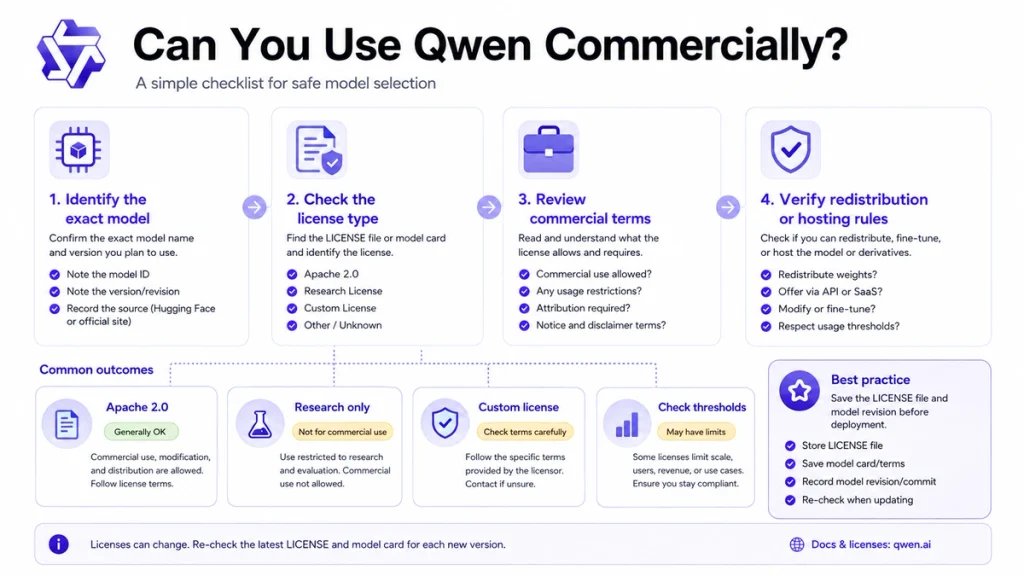
1. Are Downloadable Weights Available?
- No: Review the hosted service or API terms.
- Yes: Continue to the exact model repository.
2. Does the Exact Repository Use Apache 2.0?
- Yes: Commercial use, modification, hosting, and redistribution are generally permitted with Apache compliance.
- No: Identify and read the custom license.
3. Does It Use the Qwen Research License?
Keep the use limited to research or evaluation unless a separate commercial license is obtained.
4. Does It Use the Qwen or Tongyi Qianwen License?
- Review the commercial threshold.
- Review redistribution notices.
- Review downstream-model and output clauses.
- Determine whether separate authorization is required.
5. Does It Use the Qwen3.8-Max License?
- Check the 100-million-MAU and US$20-million-monthly-revenue attribution thresholds.
- Determine whether the business qualifies as MaaS or an AI Work Assistant.
- Calculate aggregate licensee and affiliate revenue.
- Determine whether access remains internal or is provided to third parties.
- Obtain a separate license where required.
6. Are You Using a Quantization or Derivative?
Review both the original Qwen model license and the downstream repository’s terms.
7. Are You Using a Hosted Provider?
Add the provider’s terms, model-identity documentation, data policy, and regional conditions to the review.
Pre-Deployment Qwen License Checklist
- Record the exact Qwen Model ID.
- Confirm that the repository is official or document the downstream publisher.
- Record the commit SHA or fixed revision.
- Save the complete LICENSE file.
- Save any NOTICE, model-card, and responsible-use files.
- Determine whether the checkpoint uses Apache 2.0 or a custom license.
- Confirm whether the planned commercial activity is permitted.
- Check monthly-active-user and revenue thresholds.
- Check whether the business type triggers a separate-license requirement.
- Review fine-tuning and derivative-work conditions.
- Review redistribution and attribution requirements.
- Check clauses affecting outputs or downstream AI training.
- Review trademark limitations.
- Review the licenses of datasets, tokenizers, inference engines, and other dependencies.
- Review provider terms when using a hosted API.
- Document the legal entity and relevant affiliates operating the product.
- Schedule another review before changing models, launching publicly, or scaling the service.
Frequently Asked Questions
Is Qwen open source?
Qwen includes many downloadable and permissively licensed models, but the entire ecosystem is not one uniformly open-source product. “Open weight” is usually the more precise term for downloadable checkpoints, while hosted Qwen services and some model variants use separate terms.
Are all Qwen models licensed under Apache 2.0?
No. Many Qwen models use Apache 2.0, but important exceptions include Qwen3.8-2.4T-A95B, Qwen2.5-3B, Qwen2.5-72B, and Qwen2-72B. Always check the exact checkpoint’s LICENSE file.
Can Qwen be used commercially?
Many Qwen models can be used commercially. Apache-licensed checkpoints are generally the simplest choices. Custom-licensed checkpoints may also allow commercial use but can impose attribution, user-scale, revenue, business-type, or separate-license requirements.
Is Qwen free for commercial use?
An Apache-licensed Qwen checkpoint may be downloadable without a model royalty, but that does not remove infrastructure costs, license obligations, dataset restrictions, security responsibilities, or third-party software costs. Custom-licensed checkpoints require a separate analysis.
Is Qwen3 licensed for commercial use?
The original Qwen3 open-weight family is published under Apache 2.0 and can generally be used commercially in compliance with that license. Later generations must be checked individually. For example, Qwen3.8-27B uses Apache 2.0, while Qwen3.8-2.4T-A95B uses the custom Qwen3.8-Max License.
Is Qwen3.8-Max licensed under Apache 2.0?
No. The official Qwen3.8-2.4T-A95B repository is labeled qwen3.8-max and contains the Qwen3.8-Max License. The smaller Qwen3.8-27B checkpoint uses Apache 2.0.
Can I use Qwen2.5-3B in a commercial app?
Not under the default Qwen Research License. Its ordinary grant is limited to non-commercial research or evaluation. Commercial use requires a separate license.
Can I use Qwen2.5-72B commercially?
Its custom Qwen License Agreement permits commercial use subject to the agreement. A separate license is required when the commercially using product or service exceeds 100 million monthly active users. Redistribution and attribution requirements also apply.
Can I fine-tune and sell a Qwen model?
Potentially. Apache-licensed models generally permit modification and commercial redistribution when the required license and notices are preserved. Research-licensed checkpoints require separate commercial permission. Custom Qwen licenses must be checked for attribution, thresholds, and downstream-model conditions.
Can I create a GGUF version of a Qwen model?
The technical conversion does not determine the legal answer. Check whether the base model license permits modification and redistribution, then preserve all applicable upstream terms in the GGUF release.
Can I use Qwen outputs to train another model?
It depends on the exact license and access method. Certain custom Qwen licenses explicitly regulate using the model or its outputs to create or improve another AI model. Hosted-service terms may impose additional conditions.
Does a third-party provider’s commercial-use label replace the Qwen license?
No. The provider’s terms govern the hosted service relationship. The underlying model license can remain relevant, especially for restrictions, derivatives, output use, and redistribution.
Does the Qwen GitHub repository license apply to every Qwen model?
Not necessarily. A GitHub repository’s software license can differ from the license distributed with a specific model’s weights. The Qwen3.8 repository explicitly directs users to the license released with each checkpoint.
Conclusion
Qwen should be understood as a mixed open-weight model ecosystem, not a single product governed by one license.
Many current Qwen checkpoints use Apache 2.0 and provide broad commercial rights. However, the exceptions are important:
- Qwen2.5-3B is limited to research or evaluation under its default license.
- Qwen2.5-72B uses a custom agreement with a 100-million-MAU threshold.
- Qwen2-72B uses an older custom license with additional downstream-model restrictions.
- Qwen3.8-2.4T-A95B uses the new Qwen3.8-Max License with product-scale attribution and special MaaS or AI Work Assistant conditions.
- Qwen3.8-27B remains licensed under Apache 2.0.
Before using Qwen commercially, verify the exact Model ID, repository owner, LICENSE file, revision, deployment method, provider, product architecture, and business model.
Do not rely only on the family name, parameter count, search-result summary, API marketplace label, or license attached to a general GitHub repository.
Main Sources Used
- Official Qwen3.8 GitHub Repository
- Official Qwen3.8-27B License
- Official Qwen3.8-2.4T-A95B License
- Official Qwen3 GitHub Repository
- Official Qwen3.5-397B-A17B License
- Official Qwen3.6-27B License
- Official Qwen3.6-35B-A3B License
- Official Qwen2.5 LLM Release and License Table
- Official Qwen2.5-3B Research License
- Official Qwen2.5-72B-Instruct License
- Official Qwen2 Release and Licensing Overview
- Official Qwen2-72B-Instruct Tongyi Qianwen License
- Open Source Initiative: Open Source AI Definition
- Apache License, Version 2.0
Last verified: August 24, 2026
Evidence status: Documentation-Verified
[…] The ability to download a Qwen checkpoint does not automatically establish commercial permission or redistribution rights. Review the exact checkpoint’s license before deployment, modification, or distribution. See Qwen Open-Weight Models and Licenses Explained. […]
[…] licensing and commercial-use details, read Qwen Open-Weight Models and Licenses Explained. For hosted-versus-local data handling, see Qwen Studio vs API vs Local Models: Privacy […]