
A correctly secured local or self-hosted Qwen deployment usually provides the greatest technical privacy control because prompts do not have to leave the organization’s environment. Qwen Studio provides the least configuration control because it is a consumer-facing hosted service. Qwen APIs sit between those options, but “Qwen API” is not one privacy profile: QwenCloud, Alibaba Cloud Model Studio, and third-party providers have different training, storage, logging, regional, and contractual terms.
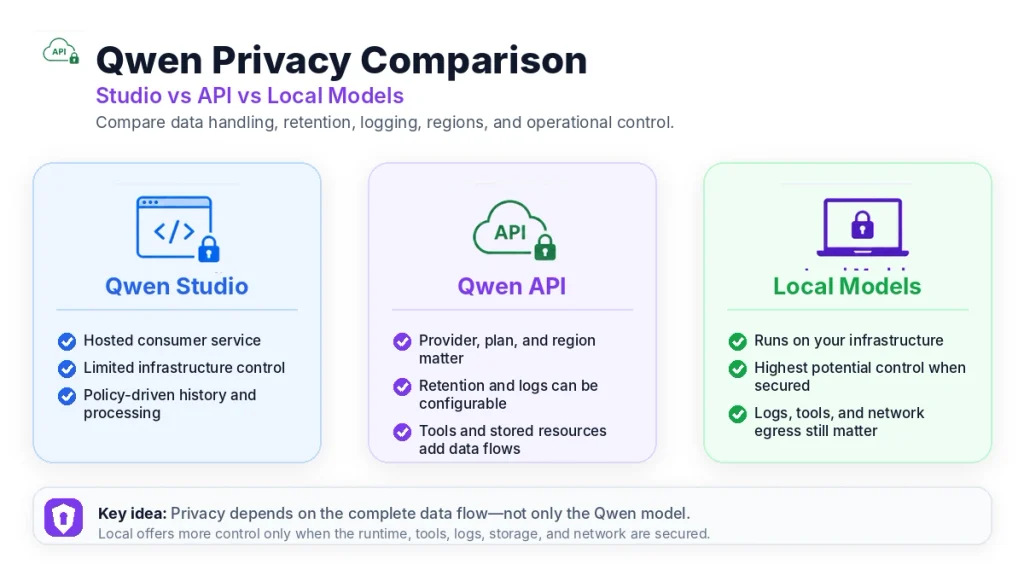
The model name alone does not determine privacy. The important questions are who receives the prompt, where processing occurs, whether content is stored or used for improvement, what logs are created, which external tools receive data, and who controls deletion and access.
Privacy and legal note: This guide compares published policies and technical controls. It is not legal advice and does not certify any Qwen service or deployment for confidential, regulated, or personal data. Review the current contract, privacy documents, region, configuration, and complete data flow for your use case.
Qwen Studio vs API vs Local Privacy at a Glance
| Access method | Where prompts go | Published training position | Storage and logging | Level of control | Typical privacy fit |
|---|---|---|---|---|---|
| Qwen Studio | Qwen’s hosted consumer service | De-identified User Content and feedback may be used to improve services, including AI models; an opt-out request is described in the training summary | Service history, usage data, feedback, and other records may be retained according to the policy | Low | Public, synthetic, or properly sanitized content |
| QwenCloud API | QwenCloud infrastructure and moderation systems | Current documentation says inputs and outputs are not retained for model training | Ordinary requests are described as memory-only, but Responses, Conversations, files, jobs, metadata, and audit logs have separate behavior | Medium to high | Governed application workloads after configuration and contract review |
| Alibaba Cloud Model Studio API | The selected region and the configured inference deployment scope | Member Content is not used to develop or improve models without separate consent | Feature-specific storage includes console history, operational metrics, optional inference logs, files, knowledge bases, and application resources | High | Enterprise workloads requiring regional, workspace, identity, and monitoring controls |
| Third-party Qwen API | The independent provider operating the endpoint | Depends entirely on that provider and plan | Provider-specific | Variable | Only after reviewing the exact provider, product, region, and agreement |
| Local or self-hosted Qwen | Your device, server, data center, or private cloud | No external model provider receives prompts when inference is genuinely local and external calls are disabled | You control application logs, histories, files, backups, databases, and monitoring | Potentially highest | Privacy-sensitive workloads when the complete environment is properly secured |
This comparison is a starting point. An insecure local server exposed to the internet can be less private than a carefully configured enterprise API. Conversely, a consumer chatbot account should not be treated as equivalent to a region-controlled business API merely because both use a Qwen model.
The First Privacy Rule: Qwen Is Not One Data Flow
People often ask whether “Qwen” stores prompts or trains on user data. That question combines several products and deployment models that do not share one data path.
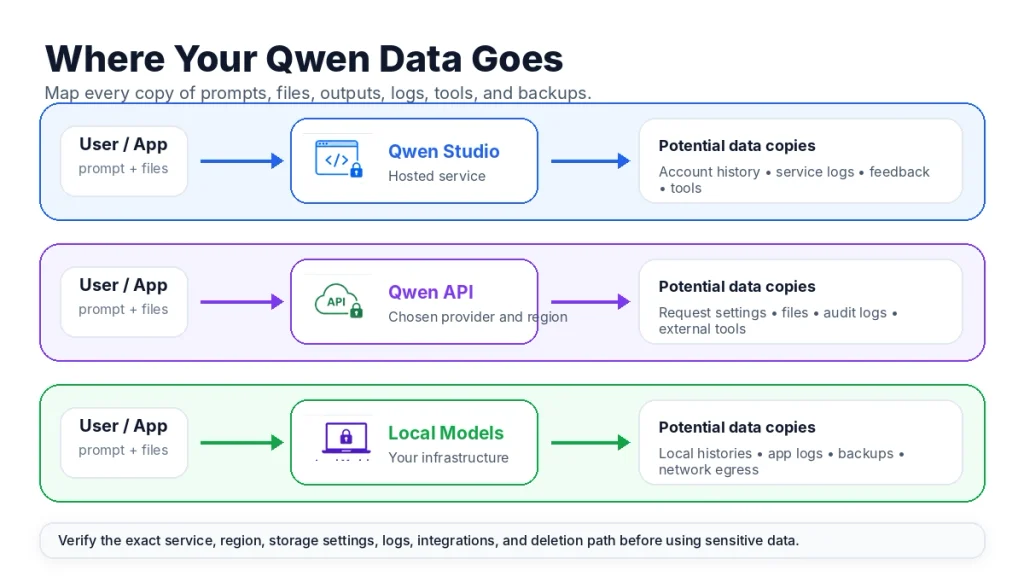
A request can reach Qwen through:
- The Qwen Studio website or app.
- A QwenCloud pay-as-you-go, Token Plan, or Coding Plan endpoint.
- Alibaba Cloud Model Studio in a selected region.
- A third-party service that hosts Qwen models.
- A local desktop runtime such as llama.cpp, Ollama, or LM Studio.
- A self-hosted server using vLLM, SGLang, Transformers, or another inference framework.
- An application such as Qwen Code that connects to one of several possible providers.
Each route can have a different legal entity, endpoint, account type, region, retention period, logging configuration, model-improvement policy, and external tool chain.
What Qwen Studio, API, and Local Models Mean
Qwen Studio
Qwen Studio is the hosted consumer AI assistant available through Qwen’s website and supported applications. The service manages the interface, accounts, conversation history, files, model execution, safety systems, and product analytics.
The user receives convenience but has limited control over the underlying infrastructure, data-processing locations, service logs, model-improvement systems, or internal deletion process.
Qwen API
“Qwen API” can refer to more than one service. The most important distinction is between:
- QwenCloud: A developer platform with OpenAI-compatible and other API interfaces, workspaces, API keys, model plans, and published data-handling documentation.
- Alibaba Cloud Model Studio: An enterprise-oriented platform with regional services, workspaces, RAM permissions, monitoring, application resources, knowledge bases, and multiple model families.
- Third-party Qwen APIs: Independent providers that serve a Qwen checkpoint under their own policies and infrastructure.
Even when two services expose an OpenAI-compatible endpoint and the same Model ID, their privacy terms can differ.
Local or Self-Hosted Qwen
A local deployment uses downloadable Qwen weights on infrastructure controlled by the user or organization. It can run on a laptop, workstation, on-premises server, private data center, or cloud virtual machine managed by the organization.
“Self-hosted” does not always mean physically inside an office. A Qwen server running in a private cloud account is self-managed but still relies on a cloud provider, virtual network, storage service, administrators, and backups.
Privacy vs Confidentiality vs Security vs Data Residency
These terms should not be used interchangeably.
| Concept | Question it answers | Example |
|---|---|---|
| Privacy | How is personal or user-related data collected, used, shared, retained, and transferred? | Whether prompts may be used for service improvement. |
| Confidentiality | Is the recipient contractually required to protect the information? | An NDA, enterprise confidentiality clause, or client agreement. |
| Security | Which technical and organizational controls reduce unauthorized access or disclosure? | TLS, encryption at rest, least privilege, network isolation, and key rotation. |
| Data residency | In which geography is data stored or processed? | Restricting inference to the EU or United States. |
| Retention | How long does a copy remain available? | A stored response, chat history, file, audit record, or backup. |
| Training use | Can the content be used to develop or improve models? | Using de-identified conversations as model-improvement data. |
| Compliance | Does the complete workflow satisfy applicable legal, regulatory, and contractual requirements? | GDPR transfer requirements, healthcare rules, or customer security terms. |
A provider can promise not to train on prompts while still retaining them for a feature, support investigation, security review, legal requirement, or user-visible history. Encryption can protect stored data while authorized administrators or applications can still access it. A local model can avoid an external model provider while remaining exposed through poor access control or remote tools.
Qwen Studio Privacy
Qwen Studio is optimized for accessibility and convenience rather than maximum customer control. Its privacy profile is determined by the current Qwen Privacy Policy, Terms of Service, training disclosures, and the features used in the account.
What Qwen Studio Can Collect
The privacy policy defines User Content broadly. Depending on the feature, submitted content can include:
- Text prompts and conversation messages.
- Uploaded documents and files.
- Images, audio, and video.
- Generated content and conversation context.
- Ratings and other feedback.
- Support communications.
- Device, browser, network, log, and usage information.
- Cookie and analytics information.
A private-looking conversation interface does not mean that the service receives only the final visible prompt. Account, security, analytics, and usage systems can process additional metadata.
Does Qwen Studio Use Content to Improve Its Models?
The current policy describes using de-identified User Content and feedback to improve the accuracy and quality of Qwen services, including AI models. The separate Training Data Summary says users can submit a request to opt out of having their content used for training.
An opt-out request should not be confused with deleting history or preventing every form of processing. It addresses a stated training use, while service delivery, security, legal, support, and retention activities can be governed separately.
Feedback Can Create an Additional Record
When a user rates an output or submits feedback, the related conversation may be associated with that feedback. Avoid rating a conversation containing sensitive information unless the content has been sanitized and the feedback process is approved.
Where Qwen Studio Data Is Processed
The current Qwen Privacy Policy states that covered personal data may be stored or processed in Singapore and Mainland China. It also describes limited remote access by certain corporate-group entities under authorization and security controls.
Your physical location, interface language, or sign-in country does not by itself prove that processing remains in the same country.
Qwen Studio Retention and Deletion
Qwen Studio does not provide the same request-level retention switch that a developer can configure in an API call. Retention depends on the service purpose, account history, feedback, security, legal requirements, and other policy considerations.
Deleting a visible conversation should not be treated as proof that every copy has instantly disappeared from backups, security records, feedback systems, or legally retained data. Review the current deletion language and use a formal privacy request when required.
Qwen Studio’s Confidentiality Limitation
The standard Qwen Terms treat User Content as non-confidential and do not create a general confidentiality obligation unless a separate direct agreement provides one.
This does not mean that prompts are automatically made public. It means the consumer terms should not be treated as an NDA or enterprise confidentiality agreement.
When Qwen Studio Is the Reasonable Choice
- Questions based on public information.
- General brainstorming without internal facts.
- Editing already published content.
- Synthetic examples and test data.
- Translation of non-sensitive text.
- Documents that have been properly redacted and approved.
When Qwen Studio Is Not the Default Choice
- Trade secrets or unreleased plans.
- Unredacted customer or employee records.
- Private source code and vulnerability reports.
- Credentials, API keys, passwords, certificates, or tokens.
- Legal privilege, medical records, financial account data, or regulated identifiers.
- Information governed by a client contract that prohibits third-party processing.
For a detailed decision framework covering confidential information, read Is Qwen Safe for Confidential Data?
Qwen API Privacy Is Not One Policy
The word “API” describes a technical interface, not a privacy guarantee. Before evaluating a Qwen API, identify:
- The legal entity providing the endpoint.
- The product and account plan.
- The exact Base URL and region.
- The Model ID and whether it is a hosted or downloadable model.
- The applicable service agreement and privacy policy.
- Whether request or response storage is enabled.
- Which files, conversations, datasets, or caches are persistent.
- Whether content logging is enabled in your application or provider account.
Two applications can use the same Qwen Model ID and still have different privacy outcomes because they use different providers, regions, contracts, and logging stacks.
QwenCloud API Privacy
QwenCloud publishes developer-specific controls that are more configurable than the standard Qwen Studio consumer interface. Relevant sources include its Safety and Data Handling documentation, Data Security documentation, and Audit Log documentation.
Ordinary Request Handling
QwenCloud’s current documentation says that ordinary API inputs and outputs:
- Are processed in memory during the request.
- Are not placed in persistent storage after the response is returned.
- Are not retained for model training.
- Can still generate operational metadata such as token counts, timestamps, and request IDs.
This is a strong API-specific position, but it is not a universal promise covering every QwenCloud feature or stored resource.
Responses API: store=true vs store=false
The Responses API is an important exception. Current QwenCloud documentation states that:
store=trueis the default.- With storage enabled, response conversation data is retained for 30 days.
- Setting
store=falsedisables that response-conversation retention.
The store parameter is specific to the Responses API behavior described in the documentation. QwenCloud’s OpenAI compatibility page lists store as an unsupported parameter for Chat Completions, where it can be silently ignored. Do not add store=false to a Chat Completions request and assume it changed the provider’s behavior.
Conversations API Retention
The separate QwenCloud Conversations API automatically manages multi-turn context. Its current documentation states that conversation data is kept for up to seven days and is limited to the latest 100 entries.
Applications using previous_response_id, conversation objects, or automatic cross-session history should therefore review the Responses and Conversations documentation together.
File API and Stored Resources
Real-time request handling does not determine the retention of uploaded files, Batch jobs, datasets, fine-tuning resources, evaluations, or other persistent objects.
The current QwenCloud OpenAI compatibility overview states that files uploaded through the File API do not automatically expire. Applications should therefore delete files when they are no longer required and maintain their own inventory of File IDs and owners.
A developer should never describe an entire QwenCloud application as “zero retention” merely because its synchronous text request is memory-only.
QwenCloud Retention Summary
| Resource or feature | Current published behavior | Privacy action |
|---|---|---|
| Ordinary real-time inputs and outputs | Processed in memory and not persistently stored after the response | Still review application, proxy, and moderation data flows |
Responses API with store=true | Conversation data stored for 30 days | Use only when server-managed response state is required |
Responses API with store=false | Response-conversation retention disabled | Set explicitly for requests that do not require provider-side state |
| Conversations API | Up to seven days and the latest 100 entries | Delete conversations and avoid sensitive persistent history |
| Request-level audit logs | Operational records retained for 14 days | Confirm whether content or only metadata appears in each log layer |
| File API | Files do not automatically expire under the current compatibility documentation | Track and delete File IDs through a formal lifecycle |
| Batch, datasets, fine-tuning, and evaluation resources | Feature-specific stored resources | Review the dedicated documentation and deletion controls |
| Your own application logs | Controlled by your stack | Disable request-body logging or redact it before storage |
QwenCloud Audit Logs
QwenCloud’s Logs tab provides request-level operational records including token usage, latency, and status information. The current published retention period is 14 days.
This does not tell you what your own systems retain. Additional copies can be created by:
- Your application database.
- A reverse proxy or API gateway.
- An APM or tracing platform.
- Error-reporting software.
- Cloud load-balancer logs.
- A customer-support ticket.
- A developer’s local debug output.
QwenCloud Security Controls
The current security documentation describes:
- TLS 1.2 or later for API connections.
- AES-256 protection for stored account information and API keys.
- Workspace-specific API keys and permissions.
- Key rotation and separation between environments.
- Automatic content moderation for inputs and outputs.
- Usage analytics and audit trails.
Encryption protects data in transit or at rest. It does not remove sensitive content, create contractual confidentiality, prevent an authorized administrator from accessing a permitted system, or stop your own application from logging a request body.
QwenCloud Contractual Confidentiality
The standard QwenCloud Customer Agreement also describes User Content as non-confidential under its standard terms. A no-training or short-retention architecture is not the same as a contractual confidentiality commitment.
Organizations processing genuine trade secrets should review whether they need a separate enterprise agreement, data-processing addendum, confidentiality provision, incident-notification commitment, or other negotiated terms.
QwenCloud store=false Example
The following example uses the Responses API and explicitly disables response storage. Keep the API key and the correct regional Responses Base URL in environment variables rather than hardcoding them.
import os

from openai import OpenAI


client = OpenAI(
    api_key=os.environ["QWEN_API_KEY"],
    base_url=os.environ["QWEN_RESPONSES_BASE_URL"],
)

response = client.responses.create(
    model=os.environ["QWEN_MODEL_ID"],
    input="Summarize this already-redacted internal procedure.",
    store=False,
)

print(response.output_text)
The correct Base URL can differ by protocol, plan, and region. Retrieve it from the current QwenCloud console or documentation for the key being used.
store=False does not:
- Create an NDA.
- Redact the prompt.
- Delete files or conversation objects.
- Disable operational metadata.
- Disable your application or proxy logs.
- Control a third-party observability platform.
- Protect an exposed API key.
- Apply automatically to Chat Completions, Batch, datasets, or fine-tuning resources.
Alibaba Cloud Model Studio Privacy
Alibaba Cloud Model Studio provides a different privacy and governance profile from the Qwen Studio consumer service. It combines model APIs with regional services, workspaces, RAM permissions, application resources, monitoring, knowledge bases, files, and enterprise account controls.
Does Model Studio Use Customer Data for Training?
The current Alibaba Cloud Product Terms state that Member Content is not used to develop or improve Model Studio models unless the customer separately provides consent.
The Model Studio FAQ also describes customer data as not being used for model training.
This is a no-training commitment. It should not be rewritten as a universal no-storage or no-logging promise because Model Studio includes features that deliberately store histories, files, knowledge bases, monitoring data, and other application resources.
Region vs Service Deployment Scope
Model Studio separates two geographical decisions:
- Region: Determines the access point and location of stored request or static data associated with the service.
- Service deployment scope: Determines where inference execution can occur.
According to the current Model Studio regional documentation, the selected region receives the request and retains static data there. The request can then be forwarded to an inference node within the selected deployment scope. Transient data at that inference node is described as non-persistent, and transmissions are encrypted.
Selecting a nearby console region does not automatically restrict inference to that country. The deployment scope must also match the organization’s residency requirement.
Current Model Studio Residency Options
| Selected region | Restricted deployment option | Important privacy note |
|---|---|---|
| US (Virginia) | United States | Use the US-restricted scope when inference must stay in the US; a Global scope can use a wider resource pool. |
| Germany (Frankfurt) | European Union | Use the EU-restricted scope for EU inference boundaries; do not assume every model is available in that scope. |
| Japan (Tokyo) | Japan | The Japan-restricted scope keeps inference in Japan for supported models. |
| China (Hong Kong) | China (Hong Kong) | A Hong Kong-restricted scope is distinct from the Global scope available from the same region. |
| Singapore | International | The International scope excludes the Chinese mainland under the current documentation. |
| China (Beijing) | Chinese mainland | The Chinese-mainland scope restricts inference to Mainland China. |
Model and feature availability varies by region and deployment scope. Verify the selected Model ID, regional API key, Base URL, and scope before designing a compliance claim around a geography.
Model Studio API Keys and Workspaces
Model Studio supports data isolation through workspaces and Alibaba Cloud RAM permissions. The regional documentation also states that each region has its own API keys, access domains, and model list; credentials and model availability cannot be assumed to work across regions.
A production design should normally:
- Create separate production and development workspaces.
- Separate business units when they should not access each other’s data.
- Create individual or service-specific credentials.
- Use least-privilege RAM roles.
- Keep keys in a secrets manager.
- Rotate and revoke keys when staff or applications change.
- Use the workspace-dedicated domain recommended for production.
Model Studio Playground History
The current Model Studio FAQ says the console can display up to 100 historical Playground conversations with no stated time limit. Deleting visible records can reveal older records that were outside the displayed set.
Do not use the Playground as a temporary confidential scratchpad simply because it is not a public page. Delete test conversations when they are no longer required and restrict console access.
Model Studio Metrics and Inference Logs
Model Studio monitoring creates another important distinction between operational metrics and full-content logs.
- Call, performance, error, and token-usage metrics can be available for monitoring and cost analysis.
- The current documentation provides access to historical token-consumption data for the last 30 days.
- For supported models and regions, an authorized user can enable inference logging.
- After full inference logging is enabled, Model Studio can record the request, response, and latency for each supported model call.
- The complete request-and-response logging feature is currently limited mainly to specified models in the China (Beijing) region.
Review the current Model Studio monitoring documentation before relying on a specific regional behavior.
Full inference logs can be useful for debugging and auditing, but they also create a searchable second copy of prompts and outputs. For sensitive workloads:
- Do not enable full prompt logging by default.
- Restrict who can enable or view inference logs.
- Redact records before exporting them to a SIEM or ticketing platform.
- Document the retention period and deletion owner.
- Test whether SDKs, gateways, and APM agents capture request bodies independently.
Region-Aware Model Studio Configuration
Keep the regional Base URL outside the source code so the production environment cannot silently fall back to a different endpoint.
import os

from openai import OpenAI


client = OpenAI(
    api_key=os.environ["MODEL_STUDIO_API_KEY"],
    base_url=os.environ["MODEL_STUDIO_BASE_URL"],
)

completion = client.chat.completions.create(
    model=os.environ["MODEL_STUDIO_MODEL_ID"],
    messages=[
        {
            "role": "user",
            "content": "Analyze this already-pseudonymized support summary.",
        }
    ],
)

print(completion.choices[0].message.content)
Deployment controls should validate that:
- The API key belongs to the intended region and workspace.
- The Base URL is the approved workspace-specific domain.
- The selected model is available under the required deployment scope.
- A Global scope has not been selected accidentally.
- Logging settings match the approved data classification.
- The application fails closed rather than falling back to an unapproved provider.
Third-Party Qwen API Privacy
A third-party provider can host an official Qwen checkpoint, a quantized derivative, a fine-tuned model, or a provider-defined alias. The Qwen model name does not make Alibaba or Qwen the direct recipient of the request.
Review the third party’s:
- Legal entity and jurisdiction.
- Consumer and enterprise plan differences.
- Training and abuse-monitoring policy.
- Prompt and output retention.
- Request-body logging.
- Available regions and subprocessors.
- Deletion tools and backup policy.
- DPA, confidentiality, and incident-notification terms.
- Exact Model ID and whether requests can be routed to another model.
- Support access and human review processes.
Do not transfer QwenCloud or Alibaba Cloud commitments to an unrelated API marketplace unless that provider’s agreement expressly incorporates them.
Local and Self-Hosted Qwen Privacy
Qwen publishes downloadable model weights that can be used through frameworks such as Transformers, vLLM, SGLang, llama.cpp, Ollama, and LM Studio. The official Qwen3 repository and Qwen documentation describe local and self-hosted deployment options.
When inference runs entirely inside a controlled environment, prompts do not have to be transmitted to Qwen Studio, QwenCloud, Model Studio, or another model API.
That provides a major privacy advantage, but the correct conclusion is local gives you control—not local guarantees privacy.
Does a Local Qwen Model Send Data to Alibaba?
A downloaded model checkpoint is a collection of model and configuration files. It does not decide the network policy of the computer. Whether data leaves the environment depends on the inference runtime, user interface, libraries, tools, update systems, logs, and network configuration surrounding the model.
A genuinely offline runtime with verified dependencies and blocked network egress does not need to send prompts to Alibaba. A desktop application that calls analytics services, checks for updates, uses web search, or connects to a cloud API can still transmit information even though the model weights are stored locally.
Local Desktop vs On-Premises vs Private Cloud
| Deployment type | Privacy advantage | Main risks |
|---|---|---|
| Single-user laptop or workstation | Prompts can stay on one device with minimal infrastructure | Malware, device theft, browser extensions, unencrypted disks, local history, and excessive file access |
| On-premises server | Organization controls network, storage, identity, and physical environment | Shared accounts, exposed ports, weak segmentation, administrator access, and insecure backups |
| Private cloud or VPC | Self-managed model endpoint with cloud scalability and network controls | Cloud administrators, snapshots, object storage, public IP mistakes, managed logging, and cross-region configuration |
| Air-gapped environment | Strongest reduction of external network exposure | Removable media, supply-chain updates, insider access, offline logs, and difficult patch management |
| Hybrid local and API system | Sensitive preprocessing can stay local while selected tasks use a stronger hosted model | Routing mistakes, incomplete redaction, fallback providers, and external tool calls |
Hidden Data-Leak Paths in a Local Deployment
Data can leave or be duplicated through components that are not the Qwen model itself:
- Telemetry or crash reporting from the desktop interface.
- Automatic model downloads and update checks.
- Remote web search or web extraction.
- MCP servers and external function calls.
- Cloud-hosted embedding services or vector databases.
- Remote code execution or sandbox services.
- Centralized logs, traces, and error reports.
- Cloud backup and synchronization applications.
- Publicly exposed vLLM, SGLang, Ollama, or LM Studio ports.
- Temporary files, swap, hibernation images, and prompt caches.
- Administrators or users with excessive file-system access.
- Browser-based interfaces with third-party scripts or analytics.
Local Model Licensing Is a Separate Question
The ability to download a Qwen checkpoint does not automatically establish commercial permission or redistribution rights. Review the exact checkpoint’s license before deployment, modification, or distribution. See Qwen Open-Weight Models and Licenses Explained.
Local vLLM Privacy Baseline
The following command binds a Qwen vLLM server to the loopback interface so it is reachable only from the same machine:
vllm serve Qwen/Qwen3.8-27B \
  --host 127.0.0.1 \
  --port 8000
A local request can then be sent to:
curl http://127.0.0.1:8000/v1/chat/completions \
  -H "Content-Type: application/json" \
  -d '{
    "model": "Qwen/Qwen3.8-27B",
    "messages": [
      {
        "role": "user",
        "content": "Summarize this local test text."
      }
    ]
  }'
Binding to 127.0.0.1 is only a starting point. For a shared or production server, add:
- Authentication and per-user authorization.
- A firewall and network segmentation.
- TLS between clients and the server.
- An authenticated reverse proxy where appropriate.
- Rate limits and request-size limits.
- Safe log configuration that excludes prompt bodies.
- Encrypted disks and backups.
- Dependency pinning and vulnerability updates.
- Explicit network-egress rules.
- Isolation between users and workloads.
Do not bind an unauthenticated model server to 0.0.0.0 or a public IP merely to make testing easier.
Complete Qwen Privacy Comparison
| Privacy factor | Qwen Studio | QwenCloud API | Model Studio API | Local or self-hosted |
|---|---|---|---|---|
| External model provider receives prompt | Yes | Yes | Yes | No, when inference is fully local |
| Model-improvement use | De-identified content and feedback may be used; opt-out request described | Current docs say inputs and outputs are not retained for training | Not used to improve models without separate consent | Controlled by the operator |
| Request-level retention control | Limited consumer control | store=false for Responses API; other resources differ | Depends on API, application, and feature | Fully designed by the operator |
| Visible chat history | Consumer conversation history | Responses or Conversations state when used | Playground can display up to 100 histories without a stated time limit | Depends on the local interface |
| Operational metadata | Usage and log data collected | Token, timestamp, request ID, latency, status, and usage records | Call, cost, error, performance, and token metrics | Depends on local logs and monitoring |
| Full prompt logging | Provider-controlled | Review API and application layers | Can be enabled for supported inference logs | Controlled by the operator |
| Data-location control | Policy describes Singapore and Mainland China processing | Endpoint and plan dependent; verify current regional host | Selectable region and deployment scope for supported models | Determined by device, data center, cloud region, backups, and tools |
| Workspace and identity controls | Consumer account controls | Workspaces, keys, and permissions | Workspaces, RAM, regional keys, and dedicated domains | Must be designed and operated internally |
| Files and stored objects | Managed by the hosted service | File API and other resources have separate persistence | Files, knowledge bases, applications, histories, and datasets can persist | Stored in local or organization-managed systems |
| External tools | Provider features can access additional sources | Built-in and developer-defined tools may process data | Plugins, MCP, applications, and knowledge bases expand the flow | Local tools can still call remote services |
| Contractual confidentiality | Not provided by the standard consumer terms | Standard agreement requires review; separate terms may be needed | Depends on applicable Alibaba Cloud agreement, DPA, and negotiated terms | Depends on internal policy and infrastructure-provider contracts |
| Operational responsibility | Mostly provider | Shared | Shared | Mostly the organization |
| Potential privacy control | Lowest | Medium to high | High | Highest when correctly secured |
No Training Is Not the Same as No Storage
Privacy claims should be decomposed into specific controls.
| Claim | What it means | What it does not prove |
|---|---|---|
| No training | Content is not used to develop or improve models under the stated conditions | That prompts are not stored, moderated, logged, or reviewed for another permitted purpose |
| No persistent request storage | The main prompt and response are not saved after request completion | That metadata, files, conversation objects, caches, or external logs do not persist |
| No content logging | Operational logs exclude full prompt and response bodies | That token counts, IP addresses, timestamps, errors, or identities are not logged |
| Encryption | Data is cryptographically protected in transit or at rest | That authorized systems cannot process it or that the service creates confidentiality terms |
| Data residency | Storage or processing is restricted to a geography | That the data is not retained, trained on, or accessible to permitted personnel |
| Private network | Traffic avoids the public internet or uses a private cloud path | That the provider does not process or store the request |
| Contractual confidentiality | The recipient accepts a legal duty to protect covered information | That the technical system is securely configured |
| Self-hosted | The organization operates the model runtime | That the server, software, tools, administrators, or backups are secure |
The strongest privacy design combines several controls rather than relying on one label.
Files, RAG, Web Search, MCP, and Tools Change the Privacy Boundary
A simple text request may have a narrow data flow. Adding files, retrieval, agents, or external tools creates additional recipients and stored copies.
Uploaded Files
An uploaded document can be stored separately from the model request. Track:
- The original file.
- Extracted text and OCR output.
- Generated previews and thumbnails.
- File IDs and metadata.
- Temporary processing copies.
- Copies embedded in a conversation or Batch job.
- Application backups.
RAG and Vector Databases
A retrieval-augmented generation system can create several persistent resources:
- Original documents.
- Extracted and chunked text.
- Embeddings.
- Metadata and access-control fields.
- Retrieval queries.
- Retrieved chunks added to model prompts.
- Answer and citation histories.
A local Qwen model connected to a cloud-hosted vector database is not a fully local data flow.
Web Search and Web Extraction
Web tools may send a generated search query, URL, extracted page content, or task description to a search or extraction service. Sensitive information can leak through a query even when the final model is local.
For privacy-sensitive tasks, disable web tools unless they are required and approved. Never include customer identities, internal project names, confidential URLs, or unique incident details in a search query.
MCP and Function Calling
Function calling allows an application to send tool names and arguments to external systems. MCP servers can access files, databases, email, ticketing systems, cloud resources, or other APIs.
Review each tool as an independent data recipient. Restrict:
- Which servers can be connected.
- Which commands or functions can be invoked.
- Which arguments can contain user data.
- Whether tool results are added to prompts.
- Whether the server logs requests.
- Whether human confirmation is required.
Code Interpreters and Sandboxes
A code interpreter can create files, execute code, process uploaded data, and produce downloadable artifacts. Confirm where the sandbox runs, how long files remain, whether internet access is enabled, and who can retrieve generated artifacts.
Observability Platforms
Tracing products frequently capture prompts, model responses, tool arguments, retrieved documents, latency, and error details. Configure field-level redaction before sending traces rather than attempting to remove sensitive content afterward.
Which Qwen Option Should You Choose?
The following matrix is a general editorial guide, not an approval for a particular organization or legal regime.
| Data class | Examples | Typical Qwen approach |
|---|---|---|
| Public | Published articles, public documentation, press releases, open-source examples | Qwen Studio, an API, or local deployment can all be reasonable. |
| Internal, low sensitivity | Generic procedures, non-sensitive templates, internal drafts without identities | An approved API or local model; Studio only when organizational policy permits and content is sanitized. |
| Confidential | Customer contracts, private repositories, financial projections, employee feedback | A formally approved enterprise API with minimized data or a secured self-hosted deployment. |
| Restricted or regulated | Credentials, health records, biometrics, government secrets, payment data | Only a specifically approved and governed environment; often isolated self-hosting or a specially contracted regulated service. |
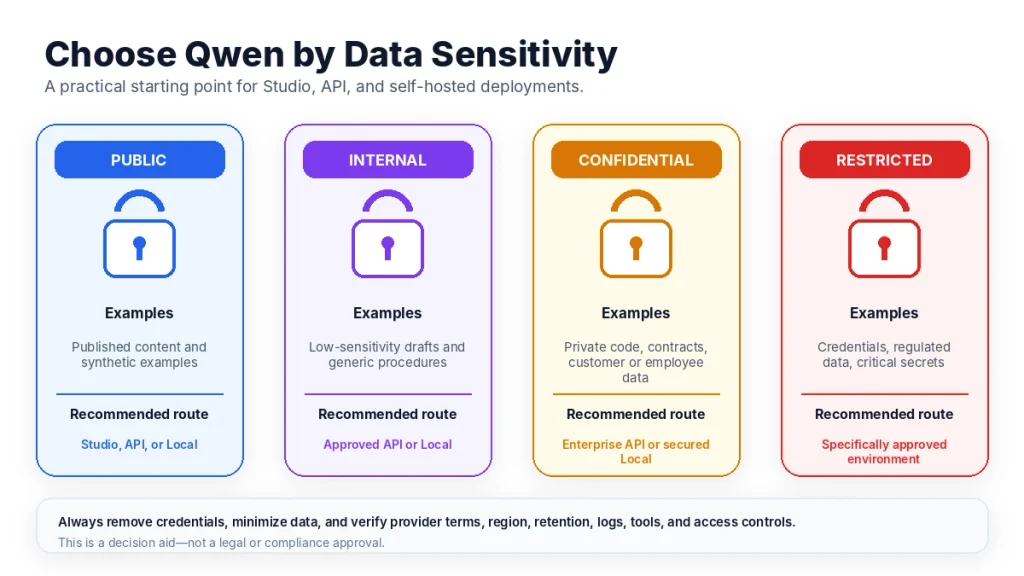
Credentials, private keys, passwords, session tokens, and production secrets should be removed rather than sent to any model.
Practical Use-Case Recommendations
| Task | Reasonable default | Privacy condition |
|---|---|---|
| Rewrite a published blog post | Qwen Studio | Exclude unpublished campaign or customer information. |
| Summarize generic internal documentation | Approved Qwen API | Remove identities, secrets, and unnecessary business details. |
| Build a customer-facing chatbot | QwenCloud or Model Studio | Configure retention, region, access, logs, and customer notices. |
| Analyze proprietary source code | Secured local model or approved enterprise API | Exclude credentials, production data, and sensitive vulnerability information. |
| Process EU-resident personal data | Approved regional Model Studio deployment or EU-controlled self-hosting | Confirm the exact scope, model availability, DPA, subprocessors, and transfer basis. |
| Search public websites | Studio or API with web tools | Do not include confidential identifiers in generated search queries. |
| Summarize restricted documents | Isolated and approved self-hosted environment | Disable unauthorized network egress, remote tools, full-content logs, and unmanaged backups. |
| Prototype a non-sensitive feature | Studio or API | Use synthetic data until the production privacy review is complete. |
Hybrid Qwen Privacy Architecture
A hybrid design can balance privacy, model quality, and infrastructure cost.
Local Redaction, Hosted Generation
A local process removes names, identifiers, secrets, and unnecessary details before sending the remaining content to an approved API. Identifiers are restored only inside the organization after the response returns.
This approach depends on reliable redaction. A hidden name inside PDF metadata, an image, a filename, or free text can bypass a simple text replacement rule.
Local Classification and Routing
A local classifier can assign each request to a data class:
- Public requests can use Qwen Studio or a general API.
- Internal requests can use an approved regional API.
- Confidential requests can use a local model.
- Restricted requests can be blocked or routed to a specially controlled environment.
The routing layer must fail closed. It should not send a confidential request to a consumer service when the local model is unavailable.
Local Retrieval, Hosted Generation
A local vector database can retrieve relevant chunks before a hosted model generates the final answer. However, any retrieved text placed into the API prompt still leaves the local environment.
Local retrieval alone does not make the complete RAG system local.
Hosted Primary Model, Local Privacy Fallback
An organization can use a hosted model for public workloads and automatically move privacy-sensitive requests to a local model. The fallback should be tested during provider outages, rate limits, and configuration failures.
How to Test a Qwen Privacy Configuration
Do not begin a privacy assessment with real customer or employee data. Use synthetic test records containing a unique canary string.
Example:
PRIVACY_TEST_QWEN_2026_8F4C2A

Synthetic customer: [TEST_CUSTOMER]
Synthetic account: [TEST_ACCOUNT]
Synthetic document: No real personal or confidential data.- Identify the exact service. Record Qwen Studio, QwenCloud, Model Studio, third-party provider, or local runtime.
- Record the legal terms. Save the current privacy policy, service agreement, DPA, and version date.
- Map the data flow. Include browser, mobile app, backend, gateway, provider, tools, database, logs, and backups.
- Confirm the Model ID and endpoint. Record Base URL, region, deployment scope, account plan, and fallback behavior.
- Send synthetic data. Never use real confidential information during initial testing.
- Search for the canary. Check conversation history, provider logs, application logs, APM traces, database records, files, and support systems.
- Test deletion. Delete the conversation, file, response, or local history and record what remains visible.
- Test account permissions. Confirm that unauthorized users and other workspaces cannot retrieve the test data.
- Test network egress. Observe whether local components contact analytics, update, search, MCP, or cloud services.
- Test tool calls. Inspect the arguments sent to every external function or MCP server.
- Test failure behavior. Disconnect the approved provider and confirm the application does not fall back to an unapproved endpoint.
- Document the result. Save the test date, configuration, policy version, evidence, owner, and next review date.
This methodology verifies observable behavior but cannot independently prove every internal provider process. Contractual and vendor due-diligence review remains necessary.
Qwen Studio Privacy Checklist
- Use public, synthetic, or properly sanitized content.
- Do not enter passwords, API keys, private keys, or production tokens.
- Review the current Qwen Privacy Policy and Terms.
- Understand that User Content can include files and multimodal inputs.
- Consider the model-training opt-out request described by Qwen.
- Avoid rating a sensitive conversation.
- Delete histories and files that are no longer required.
- Do not treat a private account as a confidentiality agreement.
- Review organizational policy before using workplace data.
Qwen API Privacy Checklist
- Identify QwenCloud, Model Studio, or the exact third-party provider.
- Record the legal entity, product, plan, endpoint, and Model ID.
- Review training, retention, deletion, and confidentiality terms separately.
- Use
store=falsefor Responses requests that do not require stored state. - Do not assume
store=falsecontrols Chat Completions or other resources. - Inventory Responses, Conversations, File IDs, Batch files, datasets, and fine-tuning jobs.
- Select the approved region and deployment scope.
- Use separate workspaces and keys for production and development.
- Store API keys in a secrets manager.
- Disable full-content logs unless formally required.
- Redact application, proxy, APM, and error logs.
- Review every external tool and subprocessor.
- Implement data minimization before the API request.
- Document deletion and incident-response procedures.
Local Qwen Privacy Checklist
- Download the model from an official or verified source.
- Record the Model ID, revision, file hashes, and license.
- Pin the runtime and dependency versions.
- Bind the service to localhost or an approved private network.
- Add authentication and least-privilege authorization.
- Block unnecessary outbound network access.
- Disable or review telemetry, crash reports, and update checks.
- Allowlist MCP servers, functions, and remote tools.
- Keep RAG storage and embeddings inside the approved boundary.
- Encrypt disks, model storage, histories, and backups.
- Exclude prompt and response bodies from standard logs.
- Restrict administrator and file-system access.
- Scan containers and dependencies for vulnerabilities.
- Separate users and workloads.
- Test deletion, backup retention, and incident response.
Common Qwen Privacy Mistakes
Treating Every Qwen Product as the Same Service
Qwen Studio, QwenCloud, Model Studio, third-party APIs, and local weights do not share one policy or data flow.
Assuming No Training Means No Storage
A provider can avoid model-training use while retaining histories, files, logs, or metadata for other purposes.
Calling a Local Model Automatically Offline
A local interface can still use cloud search, analytics, MCP servers, remote embeddings, or external monitoring.
Putting API Keys in Browser Code
A secret placed in JavaScript, a mobile bundle, or a public repository can be extracted and abused. Send requests through a secured backend.
Logging Full Requests During Debugging
Debug logs often become the longest-lived and least-protected copy of a prompt. Use synthetic data and structured redaction.
Selecting a Region but Leaving Global Inference Enabled
In Model Studio, storage region and inference deployment scope are separate decisions. Verify both.
Deleting the Visible Chat but Ignoring Other Resources
A file, conversation object, Batch result, vector record, trace, backup, or support ticket may remain after the visible message is removed.
Trusting a Qwen Logo on a Third-Party Website
The website operator, not the model family, determines who receives the request and which policy applies.
Allowing Silent Provider Fallbacks
An application may switch to another endpoint when the primary model fails. A privacy-sensitive system should fail closed or use only an approved fallback.
Frequently Asked Questions
Which Qwen option is the most private?
A correctly secured local or self-hosted deployment usually offers the greatest technical control because prompts can remain inside the organization’s environment. It is not automatically secure; the runtime, network, logs, tools, access controls, and backups must also be protected.
Is Qwen Studio private?
Qwen Studio is a hosted consumer service that collects User Content and service-related information under its Privacy Policy. It can be appropriate for public or sanitized work, but it should not be treated as a private enterprise environment for unredacted confidential data.
Does Qwen Studio use chats for training?
The current Qwen Privacy Policy says de-identified User Content and feedback may be used to improve services, including AI models. Qwen’s Training Data Summary says users can submit a request to opt out of having their content used for training.
Does QwenCloud store API prompts?
Current QwenCloud documentation says ordinary inputs and outputs are processed in memory and are not persistently stored after the response. Important exceptions include Responses API storage when store=true, Conversations API history, File API resources, Batch files, datasets, fine-tuning resources, operational metadata, and audit logs.
How long does QwenCloud store Responses API data?
The current published period is 30 days when the Responses API uses its default store=true behavior. Set store=false to disable that response-conversation retention when provider-side state is not required.
Does store=false make QwenCloud zero retention?
No. It controls one Responses API storage behavior. It does not delete files, Conversations objects, Batch resources, datasets, fine-tuning jobs, audit metadata, application logs, proxy logs, or third-party traces.
Does Alibaba Cloud Model Studio use prompts for training?
The current Model Studio product terms say Member Content is not used to develop or improve Model Studio models without separate consent.
Can Model Studio keep Qwen inference in the EU or United States?
Model Studio currently documents restricted deployment scopes for the EU through Germany (Frankfurt) and for the United States through US (Virginia), subject to model and feature availability. Select both the correct region and the restricted deployment scope; a Global scope does not provide the same boundary.
Is a local Qwen model completely private?
Not automatically. Local inference can keep prompts away from an external model API, but data can still leave through telemetry, remote tools, web search, MCP, cloud vector databases, logs, backups, updates, or exposed network ports.
Does local Qwen send data to China?
A fully local runtime with blocked external access does not need to send prompts to Qwen or Alibaba. The surrounding application determines network behavior. Verify the runtime, dependencies, telemetry, update services, tools, and outbound connections rather than relying on the word “local.”
Is Qwen API safer than Qwen Studio?
An approved API can provide stronger control over retention, keys, workspaces, regions, logging, and application access. The answer still depends on which API provider, plan, contract, endpoint, and configuration are used.
Are uploaded files treated like ordinary API prompts?
Not necessarily. Files can be separate persistent resources with their own File IDs, limits, retention, deletion process, extracted content, and use in Batch or RAG workflows. Review the file-specific documentation.
Does using a local Qwen model with web search remain local?
No. The model inference may be local, but search queries and URLs are sent to the configured search or extraction service. Treat that tool as an additional data recipient.
What determines Qwen Code privacy?
Qwen Code privacy depends on the configured model provider, authentication method, telemetry settings, files included in context, MCP servers, shell tools, extensions, logs, and approval mode. A local provider can reduce model-API exposure while external tools can still transmit code or results.
Can I process confidential data with Qwen?
Only through an environment that has been approved for the exact data category, contract, region, retention, logging, tools, and access controls involved. Do not submit unredacted confidential data to the standard Qwen Studio consumer service. See the separate guide on using Qwen with confidential data.
How often should Qwen privacy settings be reviewed?
Review them whenever the provider changes its terms, a new endpoint or region is introduced, the Model ID changes, a tool or logging platform is added, the application begins handling a new data class, or the system moves from testing to production.
Conclusion
The main Qwen privacy difference is not the model’s intelligence. It is the boundary around the model.
- Qwen Studio is the easiest option but provides the least control over data handling. Use it for public, synthetic, or properly sanitized content.
- QwenCloud API offers stronger developer controls and documents memory-only ordinary requests, but Responses, Conversations, files, audit logs, and other resources have separate retention behavior.
- Alibaba Cloud Model Studio provides no-training commitments, regional deployment options, workspaces, and enterprise controls, while histories and optional logs still require configuration and governance.
- Third-party Qwen APIs follow the third party’s policies rather than automatically inheriting QwenCloud or Alibaba Cloud commitments.
- Local Qwen models can provide the greatest technical privacy control, but the organization becomes responsible for the runtime, network, tools, logs, storage, access, patching, and incident response.
The correct decision requires more than asking whether Qwen trains on prompts. Verify the exact service, contract, endpoint, region, deployment scope, retention settings, files, logs, tools, and people who can access the data.
Main Sources Used
- Qwen Studio Privacy Policy
- Qwen Studio Terms of Service
- Qwen Training Data Summary
- QwenCloud Safety and Data Handling
- QwenCloud Data Security and Privacy
- QwenCloud Audit and Access Logs
- QwenCloud OpenAI Compatibility and Storage Behavior
- QwenCloud Conversations API
- QwenCloud Customer Agreement
- Alibaba Cloud Model Studio FAQ
- Alibaba Cloud Model Studio Product Terms
- Model Studio Regions and Service Deployment Scopes
- Model Studio Monitoring and Inference Logs
- Alibaba Cloud Data Processing Addendum
- Official Qwen3 Repository and Local Deployment Resources
- Official Qwen llama.cpp Local Deployment Guide
- Official Qwen vLLM Deployment Guide
Last verified: August 24, 2026
Evidence status: Documentation-Verified and Editorial Analysis
[…] For a detailed privacy comparison, see Qwen Studio vs API vs Local Models: Privacy Differences. […]