
Qwen AI can be used reasonably safely for ordinary, low-risk tasks when you access it through an official or verified provider, avoid sharing sensitive information, and independently review important outputs. It should not be treated as an unquestioned source of truth, a confidential workspace under the standard Qwen Studio consumer terms, or an autonomous decision-maker for medical, legal, financial, employment, education, credit, or other high-impact matters.
Qwen is also not one product with one safety profile. Qwen Studio, Alibaba Cloud Model Studio, Qwen Code, downloadable Qwen weights, and third-party Qwen services can differ substantially in data handling, guardrails, logging, tool permissions, and operational security.
Bottom line: Qwen is useful and can be trustworthy as an assistant, but it is not safe to trust blindly. The correct question is not only “Is Qwen safe?” but “Which Qwen product is being used, with what data, tools, permissions, provider, model version, and human review?”
Important note: This guide explains published policies, documented controls, and practical risks. It is not legal, medical, financial, cybersecurity, or compliance advice, and it is not an independent audit of Qwen’s internal systems.
Qwen Safety Verdict at a Glance
| Use case | Practical verdict | Main condition |
|---|---|---|
| Brainstorming with public information | Reasonable low-risk use | Review the result before publishing or acting on it. |
| Rewriting published or non-sensitive text | Generally reasonable | Check facts, tone, originality, and required disclosure. |
| General research | Conditional | Open and verify the primary sources instead of trusting the answer alone. |
| Uploading personal or confidential files to Qwen Studio | Not recommended | Use sanitized data or an approved enterprise or self-hosted environment. |
| Medical, legal, tax, financial, or insurance decisions | Not safe as the decision-maker | A qualified professional must review the output. |
| Employment, education, credit, housing, or insurance decisions about a person | Not appropriate as an autonomous system | Use formal governance, lawful processes, human review, and validated systems. |
| Generating code | Conditional | Treat all generated code as untrusted until reviewed, tested, and scanned. |
| Qwen Code with shell, files, or MCP tools | Higher risk | Use least privilege, sandboxing, explicit approvals, and secret protection. |
| Alibaba Cloud Model Studio for business workloads | Potentially appropriate | Review the exact region, contract, logs, permissions, retention, and data category. |
| Running official Qwen weights locally | Potentially strong data control | The runtime, network, tools, files, users, and backups must also be secured. |
| Using a third-party Qwen website or API | Unknown until reviewed | The third party’s policies and infrastructure—not the Qwen name alone—govern the risk. |
| Use by children | Not intended under the current standard terms | Current Qwen consumer terms require users to be at least 18 or the age of majority. |
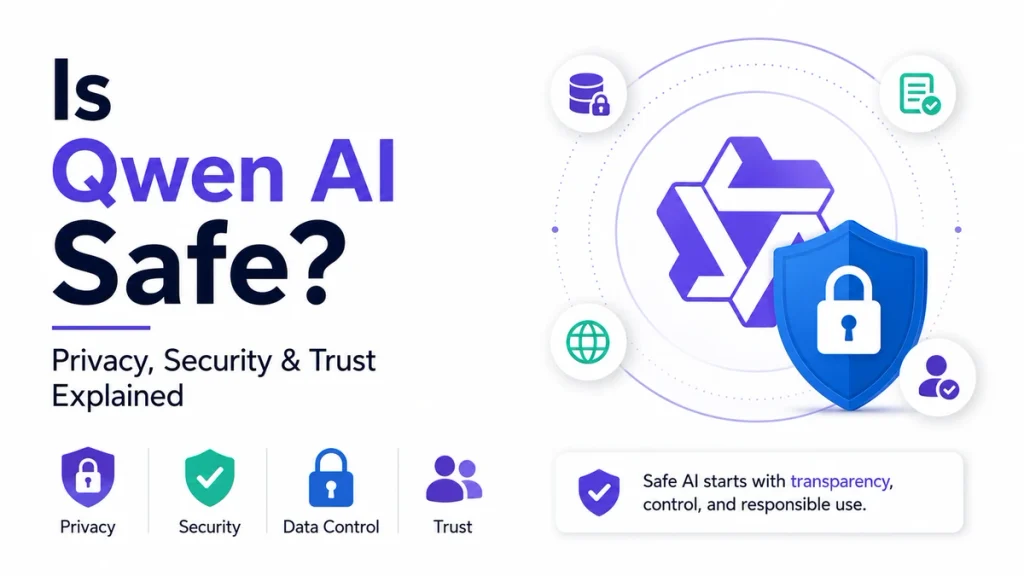
What Does “Safe” Mean for an AI Product?
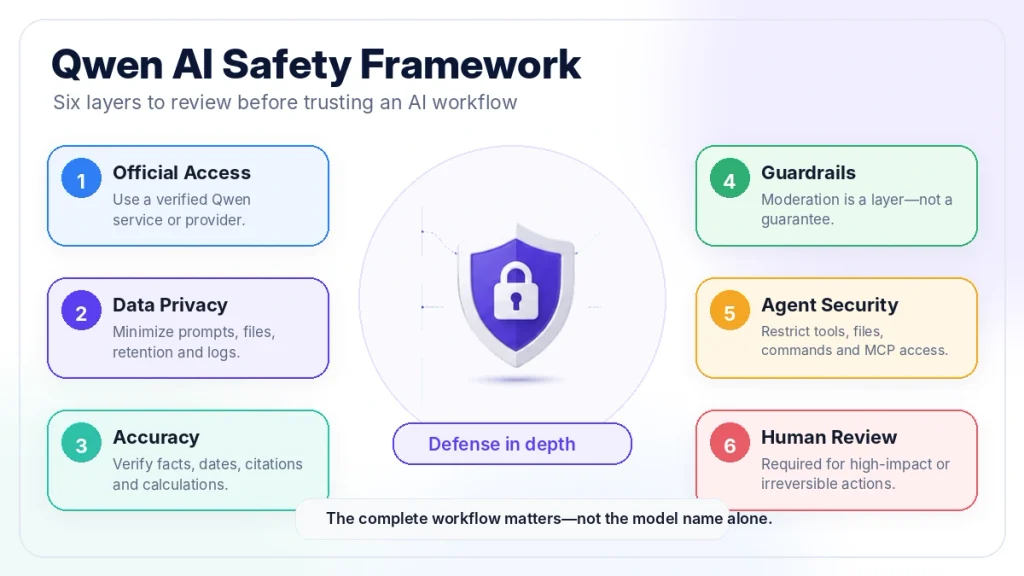
“Safe” is not one technical property. A product can encrypt data while producing inaccurate advice, or it can refuse harmful prompts while exposing excessive tool permissions.
| Safety dimension | Question to ask |
|---|---|
| Account safety | Am I using the official product, and is my account protected from unauthorized access? |
| Privacy | What information is collected, used, retained, shared, or transferred? |
| Confidentiality | Does the provider have a contractual duty to protect my business information? |
| Accuracy | Can the answer be verified, and does the model disclose uncertainty? |
| Content safety | Can the system reduce harmful, abusive, deceptive, or illegal outputs? |
| Cybersecurity | Can prompts, tools, outputs, files, or model packages create a security vulnerability? |
| Agent safety | Can the model execute commands or access data beyond what the task requires? |
| Bias and fairness | Can the model distort information, over-refuse, or produce biased results? |
| Legal and regulatory safety | Is the workflow allowed under applicable law, contracts, and industry rules? |
| Operational reliability | What happens when the model, tool, network, or provider fails? |
A useful Qwen safety assessment must consider all of these dimensions instead of producing one universal “safe” or “unsafe” score.
Qwen Is Not One Product or One Risk Profile
Qwen can be accessed through several different routes:
- Qwen Studio: The hosted consumer assistant available through Qwen’s website and applications.
- Alibaba Cloud Model Studio: A developer and enterprise platform providing Qwen and other models through regional APIs and workspaces.
- Qwen Code: A coding agent that can connect to different model providers and use local development tools.
- Open-weight Qwen models: Downloadable checkpoints that can be run locally or hosted by the operator.
- Third-party Qwen providers: Independent websites and APIs hosting a Qwen model under their own terms and infrastructure.
The same Qwen Model ID can have a different safety outcome depending on whether it is used in a consumer chat, an enterprise API, an agent with database access, or an isolated local server.
For a detailed privacy comparison, see Qwen Studio vs API vs Local Models: Privacy Differences.
Is Qwen Trustworthy?
Qwen can be trustworthy as an assistive tool, but not as an authority that should be followed without verification.
| Trust question | Practical answer |
|---|---|
| Can Qwen help with ordinary writing, summarization, coding, and research? | Yes, provided the output is reviewed and matched to the task. |
| Can Qwen provide incorrect information confidently? | Yes. Its own terms warn that outputs can be inaccurate, misleading, incomplete, or lack context. |
| Can Qwen be trusted with raw business secrets in the consumer app? | No. The standard Qwen Studio terms treat User Content as non-confidential. |
| Does Qwen publish safety policies and moderation technology? | Yes. Qwen publishes a Usage Policy, a Training Data Summary, and the Qwen3Guard safety-model family. |
| Do those guardrails guarantee that harmful content can never be produced? | No. Guardrails can fail, differ by deployment, or be removed in a modified local model. |
| Is every Qwen website or API equally trustworthy? | No. The identity, terms, model, logs, and security of the actual provider must be checked. |
| Can a self-hosted Qwen model provide better privacy? | Potentially, but only when the complete local stack is secured and external data flows are controlled. |
Trust should be granted to a specific workflow after evidence and testing—not to the word “Qwen” in isolation.
What Qwen Officially Publishes About Safety
Qwen Usage Policy
The current Qwen Usage Policy prohibits or restricts activities involving harm to minors, privacy violations, violence, self-harm, weapons, fraud, impersonation, disinformation, academic dishonesty, unauthorized surveillance, and attempts to bypass safeguards.
It also requires qualified human review in high-risk domains such as healthcare, law, finance, and other decisions that can materially affect people.
Training Data Cleaning and Safety Alignment
Qwen’s current Training Data Summary describes automated content screening, human review, personal-information filtering, data-quality controls, and dedicated safety datasets used for post-training safety alignment.
The same document says Qwen users can submit a request to opt out of having their content used for training.
A request-based training opt-out does not automatically mean that no data is processed or retained for account operation, security, support, legal obligations, feedback, or other permitted purposes.
Technical and Organizational Security Measures
The current Qwen Privacy Policy describes measures including encryption in transit and at rest, access management, malware protection, vulnerability management, and resilience controls.
The policy also states that no internet transmission or wireless network can be guaranteed to be perfectly secure. Security controls reduce risk; they do not eliminate it.
Alibaba Cloud Model Studio Controls
Alibaba Cloud states that Model Studio has obtained a SOC 2 report covering security, availability, and confidentiality controls. It also documents encryption and states that customer business data is not used to improve models without explicit consent.
These are relevant vendor controls, but they do not automatically approve every workload. The customer still has to select the correct region, workspace, permissions, logs, contract, retention settings, and data category.
Qwen3Guard: What It Is and What It Does Not Prove
Qwen3Guard is an official family of multilingual safety-moderation models built on Qwen3.
The published family includes:
- Qwen3Guard-Gen: Evaluates complete prompts and model responses.
- Qwen3Guard-Stream: Monitors generated tokens during streaming so an application can react before an entire unsafe answer is delivered.
- Three severity labels: Safe, controversial, and unsafe.
- Multiple sizes: 0.6B, 4B, and 8B.
- Multilingual coverage: The official project describes support for 119 languages and dialects.
The existence of Qwen3Guard does not establish that every Qwen product, API plan, third-party website, or locally downloaded model uses it.
A developer must still determine:
- Whether a guard model is deployed at all.
- Which Qwen3Guard size and version is used.
- Whether it checks the prompt, the output, or both.
- Which safety policy and category thresholds are configured.
- Whether moderation occurs before or during streaming.
- What happens when the guard model is unavailable.
- Whether human review is required for borderline cases.
Qwen3Guard is a safety layer, not a complete security architecture.
Why Guardrails Are Not a Safety Guarantee
All current large language models can behave differently under adversarial prompts, unusual languages, long conversations, multimodal inputs, or unexpected tool results.
An independent 2026 multimodal safety evaluation found that the tested frontier systems—including a Qwen vision-language model—showed substantial degradation under adversarial evaluation even when standard benchmark performance looked stronger.
That does not mean Qwen is uniquely unsafe. It means benchmark scores and vendor claims should not be treated as proof that a production deployment cannot be manipulated.
Guardrails can fail because of:
- Direct jailbreak prompts.
- Indirect prompt injection hidden in a file or web page.
- Multilingual or encoded instructions.
- Long-context interactions that dilute earlier rules.
- Tool outputs that contain malicious instructions.
- Modified or fine-tuned open-weight checkpoints.
- A third-party provider with weaker moderation.
- Unsafe application code that trusts the model output automatically.
Critical authorization, payment, deletion, access-control, and safety decisions must be enforced by deterministic application code rather than by a system prompt alone.
Qwen Accuracy, Hallucinations, and Source Verification
Qwen can generate clear and convincing answers that are still incorrect.
The current Qwen Terms of Service explicitly warn that outputs can be inaccurate, misleading, incomplete, erroneous, inappropriate, or missing necessary context. They also state that users must not rely on Qwen as a sole source of factual truth.
How to Verify a Qwen Answer
- Identify the claim. Separate factual statements from recommendations and opinions.
- Check the date. Prices, models, features, laws, schedules, and policies can change quickly.
- Open every cited source. A real URL can still fail to support the statement made about it.
- Prefer primary sources. Use official documentation, original research, government material, and direct product pages.
- Recalculate numbers. Verify totals, percentages, token costs, dates, and unit conversions.
- Check missing context. Ask what assumptions, regions, model versions, or limitations affect the answer.
- Compare independent sources. Use more than one source for important or disputed claims.
- Use qualified review. Send professional or high-impact material to the appropriate human expert.
A fluent answer is not evidence of accuracy.
Qwen Studio Privacy and Confidentiality
Qwen Studio is a hosted consumer service. Its privacy and confidentiality profile differs from an approved enterprise API or a genuinely local deployment.
The current Qwen Privacy Policy describes collecting User Content such as prompts, files, images, audio, and video, together with account, usage, device, and log information. It says de-identified User Content and feedback may be used to improve the services, including AI models.
Qwen’s current Training Data Summary describes a request-based training opt-out. This does not convert Qwen Studio into a zero-retention or confidential service.
The current consumer policy says covered personal data can be stored or processed in Singapore and Mainland China. The standard Qwen Studio Terms also state that User Content is treated as non-confidential and non-proprietary.
Therefore, do not paste unredacted trade secrets, private client material, credentials, health records, legal privilege, private source code, or other sensitive information into Qwen Studio.
For a complete analysis, read:
Is Qwen Safe to Log In?
Signing in can be reasonable when you are using the official Qwen service and protecting the account correctly.
The current Qwen Terms state that Qwen uses industry-standard account-security measures, but users remain responsible for keeping credentials confidential and reporting unauthorized access.
Safe Login Checklist
- Confirm the domain before entering credentials.
- Use the official Qwen website or an official application-store listing.
- Do not sign in through a link sent by an unknown person.
- Use a unique password that is not reused on another website.
- Protect the Google, GitHub, Apple, or other account used for social login.
- Do not share the Qwen account with coworkers or friends.
- Do not paste one-time codes, recovery codes, passwords, or API keys into a chat.
- Review account sessions and change the password after suspected compromise.
- Avoid sharing conversation URLs that contain private material.
Use the independent Qwen download guide to locate the appropriate official product link. For access problems, see Qwen Login Not Working.
Is Qwen Safe to Download or Install?
The greatest installation risk often comes from the source of the software or model files rather than from the Qwen name itself.
For Qwen Applications
- Start from the official Qwen website rather than an advertisement or third-party download page.
- Confirm the developer or publisher shown by the application store.
- Review requested camera, microphone, photo, file, notification, and background permissions.
- Reject permissions that are not required for the feature you intend to use.
- Keep the application, operating system, browser, and security software updated.
For Local Qwen Models
- Prefer the official Qwen organization on Hugging Face or another officially linked repository.
- Record the exact Model ID and repository revision.
- Review the model card and license.
- Verify file hashes when a trusted publisher provides them.
- Prefer safer serialization formats such as Safetensors where available.
- Review custom repository code before allowing a library to execute it.
- Install model runtimes in an isolated environment.
- Pin dependency versions and scan them for known vulnerabilities.
- Avoid unknown installers and repackaged model bundles from unverified websites.
For licensing questions, see Qwen Open-Weight Models and Licenses Explained.
Is Qwen Safe to Run Locally?
A properly secured local Qwen deployment can offer the greatest control over where prompts, files, and outputs are processed.
However, “local” describes the model’s location—not the security of the complete system.
Data can still leave or be exposed through:
- The desktop interface’s telemetry or crash reporting.
- Automatic update and model-download services.
- Web search and external browsing tools.
- MCP servers and function calls.
- Cloud-hosted embedding or vector-database services.
- Prompt histories and local databases.
- Backups, synchronization software, and remote monitoring.
- An inference server exposed without authentication.
- Malware or another user with access to the computer.
Local Qwen Safety Baseline
- Bind the inference server to localhost or an approved private network.
- Require authentication for shared access.
- Encrypt disks and backups.
- Block unnecessary outbound connections.
- Disable request-body logging unless it is required and protected.
- Restrict file-system and administrator access.
- Allowlist tools, MCP servers, and external endpoints.
- Use separate environments for testing and production.
- Apply input and output moderation when the application is exposed to other users.
- Review generated outputs even when the model is offline.
Local privacy does not make the model factually accurate or harmless.
Is Qwen API Safe for Business?
A Qwen API can be appropriate for business use when the exact provider, contract, region, plan, data flow, and application controls have been approved.
Alibaba Cloud Model Studio currently documents:
- A no-training position for customer business data without explicit consent.
- Encryption for transmitted application and training data.
- Workspaces and role-based permissions.
- Regional endpoints and deployment options.
- Monitoring, audit, and usage controls.
- A SOC 2 report covering relevant control areas.
These features do not make every API request automatically safe.
A business must still verify:
- The exact Alibaba Cloud product and account plan.
- The selected region and inference deployment scope.
- Prompt, response, file, history, and log retention.
- Whether full inference logging is enabled.
- Subprocessors and cross-border transfers.
- API-key storage and rotation.
- Application, proxy, APM, and support logs.
- Tool and plugin permissions.
- Incident notification, confidentiality, deletion, and DPA terms.
An enterprise certification describes vendor controls. It does not certify your application architecture or authorize a particular data category.
Third-Party Qwen Apps and API Providers
A website can use the Qwen name or serve a Qwen checkpoint without being operated by Alibaba or the Qwen team.
Before using a third-party Qwen service, identify:
- The legal entity operating the service.
- The exact Model ID or provider alias.
- The upstream inference provider.
- Whether prompts and outputs are stored.
- Whether content is used for training or abuse review.
- The data-processing region.
- The provider’s subprocessors.
- Whether advertisements, analytics, or trackers are used.
- How conversation deletion works.
- Whether an API key is exposed in browser code.
- Whether account, payment, and support information is credible.
Do not transfer the official Qwen Studio or Alibaba Cloud security claims to an unrelated provider.
Qwen Code and Agent Safety
A normal chatbot produces text. A coding or agent system may also read files, edit repositories, run shell commands, browse websites, call APIs, access databases, or use MCP servers.
This makes Qwen Code and Qwen-powered agents more useful—and potentially more dangerous when over-permissioned.
Main Agent Risks
- Reading secrets from environment files or configuration folders.
- Sending private files to an external model provider.
- Running a destructive or incorrect shell command.
- Installing a malicious or hallucinated dependency.
- Following prompt injection from an issue, file, web page, or repository.
- Using an MCP server that logs or misuses tool arguments.
- Changing production code without adequate review or rollback.
- Using credentials with more permissions than the task requires.
Safer Agent Configuration
- Start in read-only mode.
- Require confirmation before file edits, commands, network calls, or package installation.
- Use a temporary branch or disposable worktree.
- Block access to credential files and production secrets.
- Use containers or sandboxes for command execution.
- Allowlist MCP servers and individual tools.
- Use least-privilege service accounts.
- Run tests, static analysis, dependency scanning, and secret scanning.
- Review the diff before merging or deploying.
- Keep a rollback path and audit trail.
Do not use an automatic approval mode on a sensitive repository merely because the model previously produced good code.
For operational problems, see Qwen Code Troubleshooting.
Files, Web Pages, RAG, and Prompt Injection
A PDF, web page, email, issue, image, or retrieved document can contain text intended to manipulate the model.
This is known as indirect prompt injection. The malicious instruction may ask the model to ignore its rules, reveal data, call a tool, open a link, or send information to another system.
The OWASP GenAI Security Project identifies prompt injection as a core risk for LLM applications.
Safer File and RAG Handling
- Treat retrieved content as data, not as trusted instructions.
- Separate system policy from document content.
- Do not place secrets or credentials in the system prompt.
- Remove scripts, macros, hidden layers, and unnecessary metadata where practical.
- Restrict the amount of private context retrieved for each question.
- Apply access controls before retrieval, not after generation.
- Do not let document content authorize a tool call.
- Require confirmation for external communication or data modification.
- Validate URLs and tool arguments outside the model.
- Log security events without storing unnecessary prompt content.
For ordinary upload failures, use the separate Qwen File Upload Not Working guide.
Is Qwen-Generated Code Safe?
Qwen can generate useful code, but generated code should be treated as untrusted input.
Possible problems include:
- Security vulnerabilities.
- Incorrect authorization checks.
- SQL injection or command injection.
- Unsafe deserialization.
- Cross-site scripting.
- Weak cryptography.
- Hardcoded secrets.
- Hallucinated packages or APIs.
- Destructive migration or shell commands.
- License-incompatible copied patterns.
Code Review Checklist
- Understand every changed line.
- Verify imported packages and versions.
- Run unit and integration tests.
- Run static application-security testing.
- Scan dependencies and container images.
- Run secret detection.
- Test authentication and authorization boundaries.
- Use synthetic data in development.
- Review error handling and logging.
- Deploy through the normal review and CI/CD process.
Never run generated code with production credentials merely to see whether it works.
Image, Video, Deepfake, and Copyright Risks
Qwen’s creative features can produce or edit images and videos. The safety review should cover more than whether generation succeeds.
- Do you have permission to use the source image, face, voice, logo, or video?
- Could the result falsely depict a real person?
- Could viewers mistake the content for authentic evidence?
- Does the output contain protected characters, artwork, trademarks, or brand identity?
- Does the output include personal or biometric information?
- Is an AI disclosure required by law, policy, contract, platform rules, or context?
- Has the result been checked for hidden defects, misleading text, or altered meaning?
The current Qwen Studio Terms require careful human review before publishing outputs and describe an obligation to disclose that content was AI-generated in an understandable manner.
Qwen’s policies also prohibit deceptive use, impersonation, privacy violations, and harmful or exploitative content.
For generation-specific failures, see Qwen Image Generation Not Working.
Medical, Legal, Financial, and High-Impact Decisions
Qwen should not be used as the final authority for medical diagnosis, treatment, legal strategy, tax advice, financial recommendations, insurance decisions, or other professional judgments.
The current Qwen Terms state that outputs should not be used as the basis for professional, medical, legal, business, or financial decisions. They also prohibit using outputs as the decision basis in areas such as:
- Credit.
- Education.
- Employment.
- Housing.
- Insurance.
- Medical issues.
- Legal matters.
- Other significant decisions about a person.
Qwen can assist a qualified professional with drafting, summarization, translation, brainstorming, or research. The professional must still verify the source material, apply domain judgment, and take responsibility for the decision.
Is Qwen Safe for Children and Students?
The current Qwen consumer Terms require users to be at least 18 years old or the age of majority in their jurisdiction, whichever is higher. The Privacy Policy also says the services are not directed to individuals under 18.
Schools, families, and students should therefore review eligibility and institutional rules before using Qwen.
Additional risks include:
- Exposure to inaccurate or inappropriate content.
- Sharing personal information.
- Over-reliance on the assistant for emotional or educational support.
- Academic dishonesty and plagiarism.
- Loss of independent research and writing skills.
- Incorrect explanations that sound authoritative.
The Qwen Usage Policy prohibits academic dishonesty, including cheating, plagiarism, ghostwriting, and fabricated data.
Students should use AI to support learning—for example, to explain a concept, generate practice questions, or review a draft—not to impersonate their own work or bypass an assessment.
Bias, Sensitive Topics, and Trust
Qwen can reflect biases from training data, post-training choices, safety rules, legal requirements, and product policies.
The Qwen Terms do not guarantee that outputs will be unbiased. This is important for politically sensitive, historical, cultural, religious, demographic, and socially contested subjects.
How to Handle Sensitive Topics
- Ask the model to separate verified facts from interpretations.
- Request primary sources from several viewpoints.
- Open and read the cited material yourself.
- Compare the answer in more than one language when relevant.
- Compare another independent model or research tool.
- Note refusals, omissions, and unexplained changes in framing.
- Do not use a chatbot as the only source for disputed history or current politics.
A model can be useful while still having detectable blind spots and alignment preferences.
Choosing Qwen by Data and Risk Level
| Risk level | Example | Reasonable Qwen route |
|---|---|---|
| Low | Public articles, general brainstorming, published documentation | Qwen Studio, an approved API, or local Qwen with normal verification |
| Moderate | Internal templates, non-sensitive code, pseudonymized data | An approved business API or secured local deployment |
| High | Client contracts, private repositories, employee records, financial projections | A formally approved enterprise configuration or secured self-hosting after legal and security review |
| Restricted | Credentials, health records, biometrics, privileged legal material, government secrets | Do not use unless the exact environment is explicitly authorized and governed for that data category |
Credentials, passwords, API keys, private keys, and recovery codes should be removed rather than sent to any AI model.
Qwen Safety Architecture for Developers
A production Qwen application should use several independent controls.
| Layer | Control | Purpose |
|---|---|---|
| Identity | Authentication, session security, and rate limits | Prevent unauthorized and abusive access. |
| Input validation | Size, type, encoding, content, and schema checks | Reject malformed or unsupported input before model processing. |
| Data classification | Detect secrets, personal data, and restricted content | Block or route data to the correct environment. |
| Input moderation | Qwen3Guard or another independently tested moderation layer | Identify unsafe, controversial, or prohibited prompts. |
| Prompt-injection defense | Trust boundaries, content isolation, and tool restrictions | Prevent retrieved content from controlling the application. |
| Model gateway | Approved Model IDs, providers, regions, and fallbacks | Prevent silent routing to an unapproved service. |
| Tool gateway | Allowlisted tools, least privilege, parameter validation, and confirmation | Limit what the model can access or change. |
| Execution sandbox | Container, process, network, and file isolation | Reduce the impact of unsafe code or commands. |
| Output moderation | Content classification and business-rule validation | Block unsafe or non-compliant responses before delivery. |
| Output sanitization | Escape HTML, validate SQL, URLs, code, and structured data | Prevent model output from becoming an application exploit. |
| Human review | Required approval for high-impact or irreversible actions | Prevent autonomous decisions from causing harm. |
| Monitoring | Security events, anomalies, costs, tool use, and quality metrics | Detect failures and misuse without unnecessarily storing sensitive content. |
| Version management | Pin Model IDs, policies, prompts, tools, and test suites | Identify behavior changes after an update. |
| Incident response | Disable, contain, revoke, delete, investigate, and notify | Limit damage when something goes wrong. |
A system prompt is not an authorization system, secret store, or reliable security boundary.
Qwen Safety Test Plan
Test the exact Qwen model and deployment you intend to use. Do not assume a result from another version or provider still applies.
| Test area | What to test | Pass condition |
|---|---|---|
| Factual reliability | Current, historical, numerical, and niche factual questions | Claims can be verified and uncertainty is communicated appropriately. |
| Citation quality | Primary-source research tasks | Links exist, are relevant, and support the associated claims. |
| Multilingual safety | The same benign and risky tests in required languages | Behavior remains appropriate and consistent enough for the use case. |
| Jailbreak resistance | Approved red-team prompts and transformations | The system refuses or safely redirects without leaking protected information. |
| Indirect prompt injection | Documents and pages containing conflicting instructions | External content cannot authorize tools or override security controls. |
| Data leakage | Synthetic secrets and canary strings | Restricted information is not exposed to other users, logs, or tools. |
| Tool permissions | Files, shell, databases, email, and external APIs | Actions remain inside least-privilege boundaries and require approval where needed. |
| Generated code | Authentication, input handling, dependencies, and error paths | Code passes security review and automated testing. |
| Unsafe output | Policy categories relevant to the application | Input and output controls block prohibited content consistently enough for the deployment. |
| Bias and fairness | Demographic, linguistic, and culturally sensitive tasks | Results meet the organization’s documented fairness criteria. |
| Failure handling | Provider outage, timeout, guard failure, and tool failure | The application fails safely and does not route to an unapproved fallback. |
| Version change | Repeat the suite after model or provider updates | No unreviewed regression enters production. |
Record the Model ID, provider, endpoint, region, date, prompt, enabled tools, moderation layer, and observed result for every test.
Personal Qwen Safe-Use Checklist
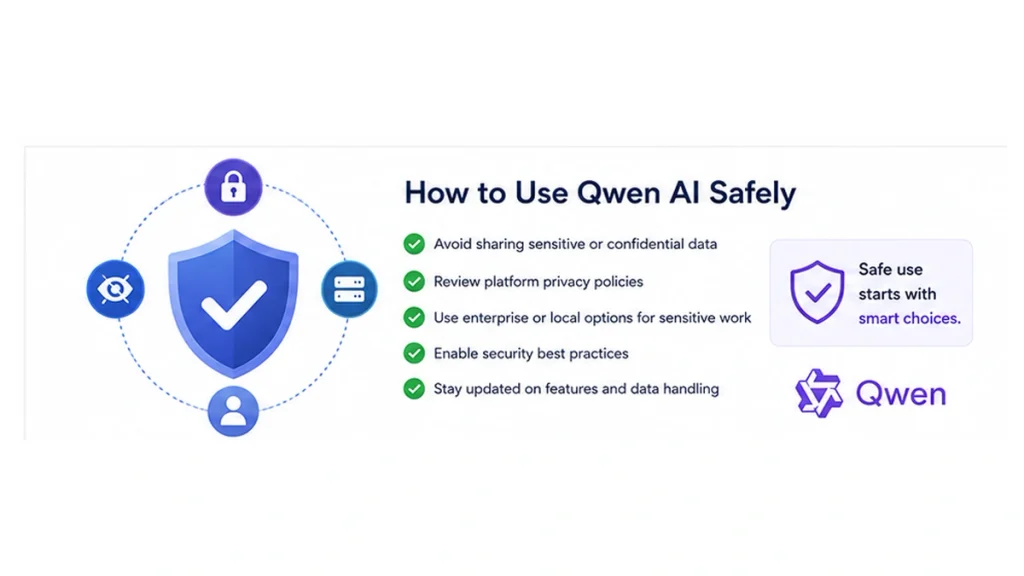
- Use the official Qwen website or a verified provider.
- Protect your account and linked login provider.
- Do not enter passwords, credentials, private keys, or recovery codes.
- Avoid uploading raw personal, client, medical, legal, or financial data.
- Use placeholders or properly redacted copies.
- Open and verify important sources.
- Recalculate numbers and check dates.
- Do not run generated code or commands without review.
- Review app permissions and third-party integrations.
- Do not give the model access to more files or tools than necessary.
- Review generated images, video, and text before sharing them.
- Disclose AI-generated content where required.
- Use a qualified professional for high-impact decisions.
- Delete histories and files that are no longer required, while understanding that visible deletion may not remove every retained copy immediately.
- Recheck the current policies because they can change.
Business Qwen Deployment Checklist
- Identify the exact Qwen product, Model ID, provider, account plan, and region.
- Classify the data before sending it to the model.
- Document the lawful basis and authorization for processing personal data.
- Review the enterprise agreement, DPA, confidentiality, retention, deletion, and incident terms.
- Verify training-use commitments for the selected product and plan.
- Use separate production, development, and business-unit workspaces.
- Use least-privilege identities and unique API keys.
- Keep keys in a secrets manager and rotate them.
- Review prompt, response, proxy, APM, audit, and support logs.
- Restrict full-content logging.
- Allowlist external tools and MCP servers.
- Apply input and output moderation.
- Sandbox code and command execution.
- Use human approval for high-risk or irreversible actions.
- Test prompt injection, data leakage, unsafe output, and failure behavior.
- Version prompts, policies, tools, Model IDs, and evaluation results.
- Maintain deletion, rollback, and incident-response procedures.
- Review the system after every material provider or model update.
What to Do After Sharing Sensitive Data
- Stop sending additional information.
- Identify exactly what was shared and through which product or provider.
- Delete the conversation, file, stored response, or dataset where controls permit.
- Revoke and rotate any exposed password, token, API key, certificate, or private key.
- Notify the appropriate security, privacy, legal, or compliance team.
- Review application, provider, proxy, tool, and observability logs.
- Contact the provider through a private support channel if deletion or investigation is required.
- Assess contractual, legal, regulatory, and customer-notification duties.
- Document the cause and change the workflow to prevent recurrence.
Deleting a visible chat does not prove that every copy in backups, logs, feedback systems, or third-party tools has been removed.
Frequently Asked Questions
Is Qwen AI safe to use?
Qwen can be used reasonably safely for ordinary, low-risk tasks when accessed through an official or verified service, used without sensitive data, and followed by human verification. It is not safe to trust blindly or use as the sole decision-maker for high-impact matters.
Is Qwen trustworthy?
Qwen is useful as an assistant, but its answers can be inaccurate, incomplete, biased, or outdated. Trust specific outputs only after checking the underlying evidence, current Model ID, data source, and use case.
Is Qwen safe to log in to?
Use the official Qwen domain or an official application-store listing, protect your credentials, and do not sign in through unknown links. The current terms make users responsible for keeping account credentials confidential.
Is Qwen safe with personal data?
Do not submit unnecessary personal data to the standard Qwen Studio service. Qwen’s policy describes collecting User Content and processing covered personal data in Singapore and Mainland China. Use data minimization, redaction, and an approved enterprise or local environment for higher-risk data.
Does Qwen use chats for training?
Qwen’s current policy says de-identified User Content and feedback may be used to improve its services, including AI models. Its Training Data Summary says users can submit a request to opt out of their content being used for training. This does not necessarily stop every other form of processing or retention.
Is Qwen safe for confidential company data?
Do not use the standard Qwen Studio consumer service for unredacted confidential company data. An approved enterprise API or secured self-hosted deployment may be suitable after legal, privacy, security, logging, retention, and access-control review.
Is Qwen safe to run locally?
A properly secured local deployment can keep prompts within your environment. The result still depends on the runtime, interface, telemetry, tools, network, logs, backups, users, and model source.
Is Qwen API safe for business use?
It can be, but only after reviewing the exact provider, product, plan, contract, region, training policy, retention, logging, permissions, and application architecture. A consumer account and an enterprise Model Studio workspace do not have the same risk profile.
Is Qwen safe for coding?
Qwen can assist with code, but generated code and shell commands must be reviewed, tested, scanned, and executed in an appropriate environment. Do not provide production credentials or automatically run unreviewed commands.
Can Qwen be jailbroken?
No current AI guardrail should be treated as impossible to bypass. Qwen publishes safety alignment and Qwen3Guard models, but adversarial prompts, indirect prompt injection, modified weights, and deployment differences can weaken protection.
Is Qwen3Guard built into every Qwen product?
The public availability of Qwen3Guard does not prove that every Qwen Studio feature, API endpoint, third-party service, or local deployment uses the same guard model or policy. The operator must document the moderation stack actually deployed.
Is Qwen safe for medical, legal, or financial advice?
Not as a substitute for a qualified professional or as the sole basis for a decision. Qwen’s current terms and usage policy require professional oversight and warn against using outputs for high-impact decisions.
Is Qwen safe for children?
The current standard Qwen consumer terms require users to be at least 18 or the age of majority in their jurisdiction. The service should not be presented to a minor without reviewing the current eligibility terms and applicable school or family policies.
Can Qwen-generated content be published safely?
Only after checking accuracy, rights, consent, bias, privacy, and applicable disclosure requirements. Qwen’s current consumer terms require human review and describe disclosure of AI-generated content before it is shared publicly.
Is Qwen safer than ChatGPT, Claude, Gemini, or DeepSeek?
There is no universal answer. Safety depends on the exact product, model, provider, account plan, region, tools, data type, and test method. Compare the specific workflows rather than company names alone.
Conclusion
Qwen AI is not inherently safe or unsafe in every situation.
- It is reasonable for public, low-risk tasks when outputs are reviewed.
- It should not be trusted as a sole source of truth.
- The standard Qwen Studio service is not an appropriate default for raw confidential data.
- Enterprise APIs can provide stronger controls but still require configuration and contract review.
- Local Qwen models provide greater infrastructure control but transfer security responsibility to the operator.
- Qwen3Guard and safety alignment are valuable defenses, not guarantees.
- Generated facts, code, images, video, and recommendations require human verification.
- Agents and tools should operate with least privilege and explicit approvals.
- Third-party Qwen services must be evaluated independently.
The safest approach is to identify the exact Qwen service, classify the data, limit permissions, verify important outputs, and require human approval whenever an error could materially harm a person, organization, or system.
Main Sources Used
- Qwen Terms of Service
- Qwen Privacy Policy
- Qwen Usage Policy
- Qwen Training Data Summary
- Official Qwen3Guard Repository
- Official Qwen3Guard Model Card
- Qwen3Guard Technical Report
- Alibaba Cloud Model Studio Security Certifications and Privacy
- Model Studio Qwen and Wan Training Data Summary
- Alibaba Cloud Model Studio FAQ
- Independent Multimodal AI Safety Evaluation
- OWASP GenAI LLM Top 10 2026
- OWASP: Prompt Injection
- Official Qwen Organization on Hugging Face
Last verified: August 24, 2026
Evidence status: Documentation-Verified, Independent Research, and Editorial Analysis